GuidesTool vs tool
Gong vs Outreach vs Salesloft: Which Wins in 2026
Gong, Outreach, and Salesloft compared on pipeline impact, automation depth, and workflow integrations for RevOps teams in 2026.

The tools compared
Some links on this page are affiliate links. If you buy through them we may earn a commission at no cost to you; it never changes a verdict. How we make money
The short answer
Gong wins on intelligence and forecasting, Outreach wins on sequencing volume and automation breadth, and Salesloft wins on deal management and coaching for enterprise teams, but none of them replace a deliberate action-trigger layer built on top.
Every RevOps team I talk to in 2026 is sitting on a mountain of conversation data and wondering why pipeline still feels like a mystery. They have Gong recording every call, Outreach or Salesloft sequencing every touch, and a CRM drowning in synced fields. What they rarely have is a system that turns a signal from one of those platforms into an action in another. That gap, not the tools themselves, is where deals die.
Gong vs Outreach vs Salesloft, broken down

Gong Top pick
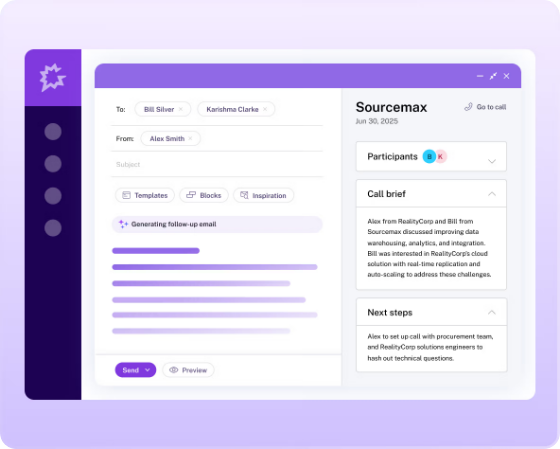
Gong's call transcription and AI deal-risk scoring are best in class, the forecasting module surfaces rep-level pipeline health, and coaching workflows annotate calls down to the moment. The catch is that Gong is passive: it tells you a deal went dark but does little to act on it, and forecasting accuracy still rides on clean CRM hygiene upstream. Pricing is opaque, usually negotiated around $1,400 to $1,600 per seat per year.
Highlights
- Best-in-class transcription and deal-risk scoring
- Rep-level forecasting plus moment-level coaching

Outreach
Outreach has the most mature sequence and task automation in the category, strong bi-directional Salesforce sync with field-level control, and a deep API you can trigger from Make or n8n. The UI is genuinely complex and onboarding drags, reporting needs real configuration to be useful, and its Kaia call intelligence still trails Gong on transcript quality. Expect $150 to $180 per seat per month after the recent price creep.
Highlights
- Most mature sequence and task automation
- Deep API for Make or n8n triggers

Salesloft
Salesloft's Deals module gives pipeline visibility closest to a lightweight CRM, Rhythm AI prioritizes rep tasks from buyer signals across email and call, and its enterprise coaching infrastructure beats Outreach with a cleaner admin experience. Sequencing has fewer conditional branches than Outreach, HubSpot integration is weaker than its Salesforce depth, and its conversation intelligence is still catching up to Gong.
Highlights
- Deals module plus Rhythm task prioritization
- Stronger enterprise coaching than Outreach
How to choose: stop asking which platform captures more, ask which one acts
The comparison most teams run is the wrong one. They evaluate Gong, Outreach, and Salesloft on feature surface area, then pick the platform with the longest list. Wrong question entirely. What actually matters is: when this tool detects a risk or opportunity, what happens next, and does that happen automatically or does it wait for a rep to notice?
Gong is genuinely exceptional at surfacing that a deal has gone dark, that a champion appeared on calls regularly and then vanished three weeks ago, or that competitive mentions spiked across the last two deal stages. The problem is that Gong’s native action layer is thin. It can push a field to Salesforce and trigger a notification. That is mostly it. Outreach has deeper action capabilities inside its own sequence engine, but the trigger logic between Gong signals and Outreach actions is not native. Salesloft’s Rhythm AI is the most interesting attempt at closing this loop natively, but it is still maturing and it is Salesforce-first in ways that frustrate HubSpot shops.
Choosing by team motion
If your team runs high-volume outbound with SDRs working hundreds of accounts, Outreach’s sequence engine is still the most battle-tested option available. Teams can run high-volume sequences through it with conditional branching on email opens, reply detection, and CRM stage changes. Salesloft’s cadence engine handles all of that more rigidly, and the difference shows at volume.
If your AEs own complex, multi-stakeholder deals with cycles running 90 days or longer, Salesloft’s Deals module and Rhythm prioritization genuinely changes rep behavior in ways a pure sequence tool cannot. I watched one enterprise team cut their average deal review prep time in half after moving pipeline management into Salesloft. That is not a marginal improvement.
If your leadership team needs forecast accuracy and coaching visibility, Gong is not optional. No other tool in this category gives a VP of Sales the ability to walk into a board meeting with call-evidence-backed forecasts. But Gong paired with nothing downstream becomes an expensive archive. Full stop.
The action-trigger layer none of them fully solve natively
This is where I spend the majority of my consulting time, working with teams running these stacks. Gong fires a deal risk alert. Someone sees it in Slack. Maybe. The deal slips anyway because the next step, enrolling the account in a re-engagement cadence, creating a CRM task for the AE’s manager, pinging the SE to schedule a technical review, lives across three different systems with no connective tissue between them.
Make and n8n are where I wire these together. The pattern I use most often is a Gong webhook (available on Business and Enterprise plans, documented in the Gong developer API docs) firing into a Make scenario that evaluates the risk signal type and then branches. Deal risk with no activity in 14 days triggers a Salesloft cadence enrollment via API, a Salesforce task creation, and a Slack DM to the rep’s manager simultaneously. A competitive mention on the last call triggers a separate branch that pulls the relevant battlecard from Notion and posts it directly to the deal’s Slack channel. Four tools, one trigger, zero manual handoffs.
This is not exotic. It is table stakes for any team spending over $80K a year on these platforms. The G2 2025 Sales Intelligence category report consistently shows that users rate “actionability of insights” as the lowest-scoring dimension across Gong, Outreach, and Salesloft, scoring below call quality, below UI, and well below pricing value. The data problem is not capture. It is action. It has always been action.
What to actually do with this comparison
If I were standing up a RevOps stack for a 20-to-100-rep B2B SaaS team today, my decision would be straightforward. Take Gong for intelligence. Pair it with Outreach if the motion is outbound-heavy, or Salesloft if the motion is enterprise deal management. Then allocate real engineering or ops time, not a side project, to building the action-trigger layer in Make or n8n.
The
Frequently asked questions
What is the difference between Gong and Outreach?
Gong is primarily a conversation intelligence and revenue forecasting platform. Outreach is a sales execution platform built around sequences, tasks, and rep workflow automation.
Is Salesloft better than Outreach for enterprise sales teams?
Salesloft edges out Outreach for complex deal management and coaching workflows, but Outreach has stronger sequence automation and bi-directional CRM sync for high-volume outbound teams.
Does Gong integrate with Salesforce and HubSpot?
Yes, Gong has native integrations with both Salesforce and HubSpot for deal and contact data, though the depth of bi-directional sync varies by plan and CRM object.
Can you replace Gong with a cheaper tool?
For smaller teams, tools like Chorus (ZoomInfo) or Fireflies.ai can approximate Gong's call recording and transcription, but Gong's deal intelligence and forecasting layers are much harder to replicate.
How do Make and n8n fit into a Gong or Salesloft workflow?
Make and n8n are used to bridge gaps where native integrations do not fire action triggers, for example routing a Gong deal risk alert into a Slack message, a CRM task, and a Salesloft cadence step simultaneously.