GuidesRevOps
The $1K/mo Enterprise RevOps Stack Decoded
When does a Salesforce + Gong + Outreach stack actually pay for itself? A framework for budgeting enterprise RevOps without premature complexity.

The verdict
Entry prices from the pricing index, read Aug 12, 2026
 Salesforce
The enterprise standard for 15+ rep orgs with complex motions
$5/mo Agentforce User Licensebilled monthly
Visit Salesforce HubSpot
The $1K stack for sub-15 rep teams with a single motion
Not in the pricing index yet
Visit HubSpot Pipedrive
The mid-tier option for outbound-heavy teams under 20 reps
Not in the pricing index yet
Visit PipedriveSome links on this page are affiliate links. If you buy through them we may earn a commission at no cost to you; it never changes a verdict. How we make money
The short answer
A $1K/mo RevOps stack is right for teams under 15 reps with a single pipeline motion; the 3x enterprise stack (Salesforce + Gong + Outreach) pays for itself only when you hit multi-segment selling, manager coaching workflows, and sequence volume above 2,000 touches per month.
Every RevOps operator I know has sat in a budget review defending a $5,000 monthly tooling line item to a CFO who just discovered that two people on the team are manually copying data between the tools they’re paying for. That conversation is almost always the wrong conversation. The real question isn’t “how much are we spending” but “at what revenue motion complexity does each tier of tooling actually produce compounding returns.” The failure mode is the same whether the team is small or large, in both directions. Either you’re paying enterprise prices for startup usage, or you’re duct-taping growth-stage tools past their ceiling and burning rep productivity in the gap.
The enterprise RevOps stack does not become expensive when you buy it. It becomes expensive when you buy it six months before your motion is complex enough to justify it.
What the $1K/mo stack actually buys you
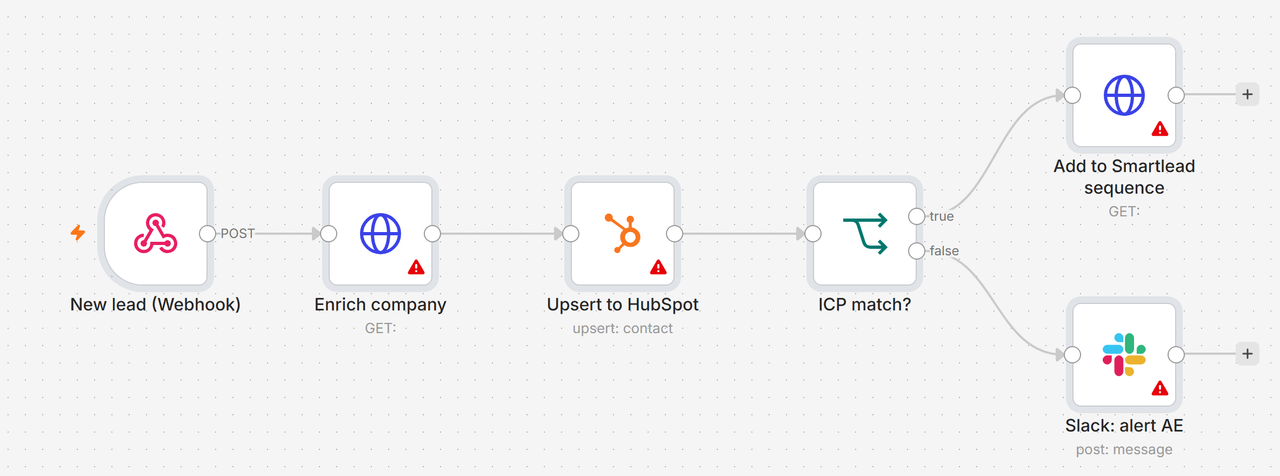
The $1K ceiling isn’t arbitrary. It’s roughly the budget where a 5-to-12-rep team can assemble a complete, non-embarrassing GTM stack using best-in-class growth-tier tools. In practice, I see this tier land around HubSpot Sales Pro ($500/mo for 5 seats) plus Apollo for prospecting data ($150/mo), Smartlead for sequencing ($100/mo), and n8n cloud for automation glue ($50/mo). That’s $800/mo with real headroom. (Below 5 reps, even this tier is premature. Start with the under-$200/mo outbound stack and graduate when the seats demand it.)
The honest limitation isn’t features. It’s operational ceiling. HubSpot’s reporting starts to groan under complex multi-touch attribution around the 15-rep mark. Apollo’s data quality degrades on hyper-niche ICPs where the contact universe is under 5,000 accounts. Smartlead lacks the bi-directional Salesforce sync that enterprise AEs expect after their first ramp month. Salesforce’s own State of Sales report shows that reps at companies with mature CRM adoption spend 28% more time on core selling activities. But “mature CRM adoption” requires admin investment the $1K stack simply doesn’t budget for. Know that going in.
The build-vs-buy line for automation is where I see the most money left on the table. Teams hit 3,000 Zapier tasks per month, see a $300 overage, and either cap their automations or upgrade to a $600/mo Zapier plan without stopping to ask whether the workflows themselves deserve to exist. Bad move, almost every time.
n8n’s self-hosted tier removes per-task pricing entirely. For teams with a technical RevOps hire or a contractor who can manage a $20/mo VPS, this is one of the highest-return budget decisions available. The tradeoff is real: you own the uptime, the updates, and the debugging. I wouldn’t recommend it for a solo RevOps generalist who is also managing territory planning and QBR prep. But if you have the technical coverage, the cost math is brutal in your favor.
When 3x stacking actually pays for itself
The enterprise stack budget conversation changes entirely once three conditions are true at the same time. Miss even one and you’re buying complexity you can’t operate.
First, you need 15 or more quota-carrying reps across at least two segments (SMB and mid-market, or mid-market and enterprise). That’s where Salesforce’s territory management, custom objects, and role hierarchy start pulling actual weight. Below that headcount, a HubSpot admin can replicate 90% of the functionality in an afternoon.
Second, you need a dedicated sales manager whose job is rep coaching. Gong’s call intelligence is genuinely irreplaceable once someone is paid to act on it. Say a team buys Gong for 8 reps with no sales manager and uses it exclusively for deal risk alerts. That’s an expensive annual subscription functioning as a Slack notification. Don’t do it.
Third, you need 2,000 or more outbound touches per month with multi-step sequences that require bi-directional CRM sync. That’s where Outreach earns its margin over Lemlist or Smartlead. Below those thresholds, the enterprise stack is complexity theater. The tools are real. The ROI isn’t.
Enterprise RevOps Stack vs Growth Alternatives
Salesforce + Gong + Outreach
The enterprise standard for 15+ rep orgs with complex motions
Pricing: Agentforce User License: $5/mo, billed monthly Pricing index, read Aug 12, 2026
- Best-in-class data model flexibility
- Gong call intelligence drives rep coaching ROI
- Outreach sequences with true SFDC bi-directional sync
- Ecosystem of 3,000+ native integrations
- Minimum $4,500/mo for 10 reps before admin cost
- 18-month average time to full SFDC adoption
- Requires dedicated SFDC admin at scale
- Gong ROI requires active manager coaching workflow
HubSpot + Smartlead + n8n
The $1K stack for sub-15 rep teams with a single motion
Pricing: From $650/mo (10 reps)
- All-in under $1K/mo for 10 reps
- HubSpot CRM requires zero admin overhead at this scale
- Smartlead handles 10K+ monthly emails reliably
- n8n automation replaces Zapier at a fraction of the cost
- HubSpot reporting hits ceiling at complex attribution
- No native call intelligence unless you add Chorus or Wingman
- Smartlead SFDC sync requires n8n middleware
- Scales poorly past 20 reps without a CRM migration
Pipedrive + Clay + Lemlist
The mid-tier option for outbound-heavy teams under 20 reps
Pricing: From $900/mo (10 reps)
- Pipedrive UI adoption is genuinely faster than both HubSpot and SFDC
- Clay enrichment quality rivals Apollo for specific ICPs
- Lemlist deliverability tooling is best-in-class for cold outbound
- Pipedrive reporting is weak without a BI layer
- Clay cost scales with enrichment volume (watch your credits)
- No native call intelligence product in the stack
The actual calculation to run before upgrading
One number. Run it before you approve anything.
Take your last two quarters of influenced pipeline (any deal where a tool touchpoint appears in the contact or account record), divide by your monthly tooling cost multiplied by six, and you have a tooling ROI ratio. A healthy ratio is 20:1 or better. Teams that run this number quarterly almost never get surprised in budget reviews, because they’ve already caught the utilization rot before it becomes a CFO conversation.
[G2’s RevOps
Frequently asked questions
What does a typical enterprise RevOps stack cost per month?
A full Salesforce + Gong + Outreach stack runs $3,000 to $8,000 per month for a 10-rep team before admin overhead. The $1K threshold is where mid-market teams should start stress-testing whether lighter alternatives cover 80% of the need.
When should a startup switch from HubSpot to Salesforce?
I'd move at 15 to 20 quota-carrying reps with complex multi-object deal structures, multiple pipelines, or enterprise CPQ needs. Below that, the admin overhead of Salesforce usually costs more than the platform savings.
Is n8n a viable alternative to Zapier for RevOps automation?
Yes, for teams with a technical RevOps hire or contractor. n8n's self-hosted option can cut automation costs by 60 to 80 percent versus Zapier at volume, and it handles multi-step logic far better.
What are the best Outreach alternatives for smaller RevOps teams?
Smartlead and Lemlist cover most sequencing needs for under $200 per month combined. Outreach earns its price at 20-plus reps who need Salesforce bi-directional sync, call recording integration, and rep coaching workflows.
How do I calculate enterprise RevOps stack ROI?
Divide pipeline influenced per quarter by total tooling cost. A healthy ratio is 20:1 or better. If your $5K monthly stack is not touching at least $100K in influenced pipeline, you have a utilization problem before a budget problem.