GuidesTool vs tool
Outreach Alternatives for Mid-Market RevOps in 2026
Actively churning from Outreach? Here's how Apollo, Pipedrive, and HubSpot Sequences stack up on cost, features, and ops complexity for mid-market teams.

The verdict
Entry prices from the pricing index, read Aug 12, 2026
 Apollo.io
Sequences + prospecting database in one platform
$49/mo Basic Planbilled monthly
Try Apollo.io HubSpot
Best if your CRM, marketing, and engagement live in HubSpot
Not in the pricing index yet
Visit HubSpot
Some links on this page are affiliate links. If you buy through them we may earn a commission at no cost to you; it never changes a verdict. How we make money
The short answer
Apollo is the sharpest cost-per-feature swap for most mid-market teams, HubSpot Sequences wins if you are already consolidated on HubSpot CRM, and Pipedrive fits if your sequences are simple and you want one less vendor.
If you are reading this, you are probably staring at a renewal quote from Outreach and doing the math on whether the platform still earns its seat cost. I have been in that meeting three times in the last 18 months with teams in the 50-to-300 rep range, and the conversation always lands in the same place. Outreach built something genuinely powerful. But the pricing model and onboarding overhead increasingly price out teams that do not have a dedicated sales-tech admin. The good news: the alternatives have caught up fast.
This comparison weighs mid-market fit and capability. If a hard budget ceiling is the real constraint rather than fit, read Outreach alternatives under $300/mo instead.
Outreach Alternatives: Mid-Market Comparison 2026
Apollo
Sequences + prospecting database in one platform
Pricing: Basic Plan: $49/mo, billed monthly Pricing index, read Aug 12, 2026
- Built-in contact and company database (270M+ contacts)
- Multi-step email, call, and LinkedIn sequences
- Native Salesforce and HubSpot CRM sync
- AI email generation and sequence suggestions
- Affordable per-seat pricing with generous free tier
- Deliverability tools lag behind Smartlead or Instantly for high-volume sending
- Reporting depth is thinner than Outreach for enterprise analytics
- Conversation intelligence is add-on only, not native
HubSpot Sequences
Best if your CRM, marketing, and engagement live in HubSpot
Pricing: Sales Hub Pro from $90/seat/month
- Sequences, CRM, and deal tracking in one license
- No data sync headaches between engagement and CRM
- Strong reporting tied directly to pipeline and revenue
- Easy rep adoption for teams already in HubSpot
- Sequences limited to enrolled contacts with a valid owner
- No native dialers or call intelligence
- Less flexible branching logic than Outreach or Apollo
- Cost climbs fast if you also need Marketing Hub
Pipedrive
Simple CRM with lightweight email sequences
Pricing: From $49/seat/month (Professional)
- Clean, low-friction UX that reps actually adopt
- Email sequences included at mid-tier plans
- Automations cover most simple drip workflows
- Strong value at the $50-70 per seat range
- Sequences are email-only, no call steps or LinkedIn tasks
- No contact database, needs Apollo or Clay for prospecting
- Limited sequence branching and A/B testing
- Reporting is pipeline-focused, not engagement-focused
How to choose the right Outreach replacement
The decision almost always comes down to two questions: where does your source-of-truth CRM live, and what is the real sending volume per rep per month.
If your team is Salesforce-native and averaging more than 400 touchpoints per rep per month, Apollo is the only one of these three that handles the volume and syncs back to Salesforce without a brittle Zapier layer holding things together. I have watched HubSpot Sequences stall out when reps hit enrollment limits and start creating duplicate contacts to work around them. That is not a training problem. That is a tool mismatch.
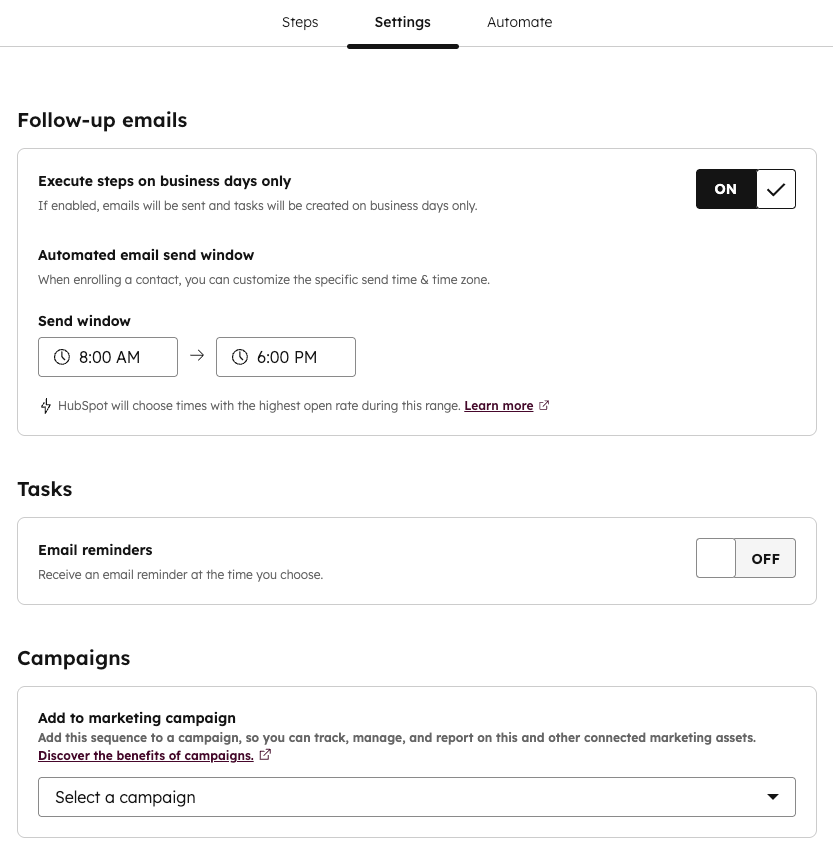
If you have already consolidated your GTM stack on HubSpot, adding Sales Hub Professional to get sequences is a much easier internal sell than standing up a second vendor. The ops overhead is lower, reporting is cleaner because deal data and engagement data share the same schema, and your enablement team trains reps on one interface instead of two. The caveat: HubSpot’s documentation on sequences makes clear that sequences only work for contacts with an assigned owner and a tracked email. High-volume outbound to cold lists will hit friction fast.
Decision criteria that actually matter
Start with CRM. If you are on Salesforce, Apollo’s native SFDC sync is meaningfully better than Pipedrive’s and comparable to Outreach’s without the price tag. If you are on HubSpot CRM, sequences are already half-built into your existing license.
Then look at sending volume. Teams averaging under 200 touchpoints per rep per month rarely need Outreach’s governance and admin controls. That is exactly where Pipedrive’s simplicity becomes a feature, not a limitation.
Finally, factor in prospecting. If your reps are building lists inside Outreach today using a separate data vendor like ZoomInfo or Cognism, moving to Apollo consolidates that spend.
Make the switch without burning your pipeline
Before you cancel the Outreach contract, export your sequence performance data, open rates, reply rates, step-level conversion, and use it to prioritize which sequences to rebuild first. The Outreach platform documentation on data exports covers the CSV format for sequence and prospect data. Rebuild your top five sequences by reply rate. Get three reps running them in the new platform. Validate deliverability before you cut over the full team.
That 4-to-6 week window is not pessimism. It is the minimum needed to avoid a pipeline gap. According to Salesforce’s State of Sales report, rep productivity drops an average of 12 percent during tool transitions. A phased cutover is worth every extra week of dual-running costs.
The alternatives have genuinely matured. Teams that have made clean migrations to Apollo or HubSpot Sequences are not missing Outreach. What they are missing is the six months they spent rationalizing the renewal before pulling the trigger.
Frequently asked questions
What is the best Outreach alternative for mid-market teams?
Apollo is the most cost-effective swap for mid-market teams that need sequences plus a built-in contact database. HubSpot Sequences is the better fit if your team already runs CRM and marketing on HubSpot.
Is Apollo a good replacement for Outreach?
Yes for most mid-market use cases. Apollo covers multi-step email and call sequences, a prospecting database, and basic analytics at a fraction of Outreach's per-seat cost.
How much does Outreach cost compared to alternatives?
Outreach is typically quoted at $100-$140 per seat per month for mid-market contracts. Apollo Pro runs around $49 per seat, and HubSpot Sales Hub Professional starts at $90 per seat with sequences included.
Can Pipedrive replace Outreach for sales engagement?
Pipedrive can replace Outreach if your sequences are simple (under 5 steps, email only) and you want CRM and engagement in one tool. It lacks the call recording and AI analytics Outreach provides.
What do I lose when switching away from Outreach?
The biggest losses are Outreach's conversation intelligence (Kaia), deep Salesforce bi-directional sync, and governance controls like sequence lockdowns. Budget for a 4-6 week re-enablement period regardless of which tool you choose.