GuidesTool vs tool
Pipedrive vs Apollo Outbound: Which Wins in 2026
Head-to-head on Pipedrive vs Apollo outbound. When native automation wins vs when Apollo's deliverability stack is worth the switch.

The tools compared
Entry prices from the pricing index, read Aug 12, 2026
Some links on this page are affiliate links. If you buy through them we may earn a commission at no cost to you; it never changes a verdict. How we make money
The short answer
Use Pipedrive's native automation when your outbound is relationship-led and CRM-first. Switch to Apollo when you are running dedicated cold outbound at volume and deliverability is a first-class concern.
The question I get from B2B SaaS founders more than almost any other right now is some version of: “We’re already on Pipedrive, do we actually need Apollo, or can we just run sequences inside Pipedrive?” Fair question. Both tools have expanded aggressively into each other’s territory over the past two years. The honest answer depends on your sending volume, your team’s motion, and whether “outbound” means 50 personalized touches a week or 5,000 cold emails a day.
Pipedrive vs Apollo, broken down
Pipedrive
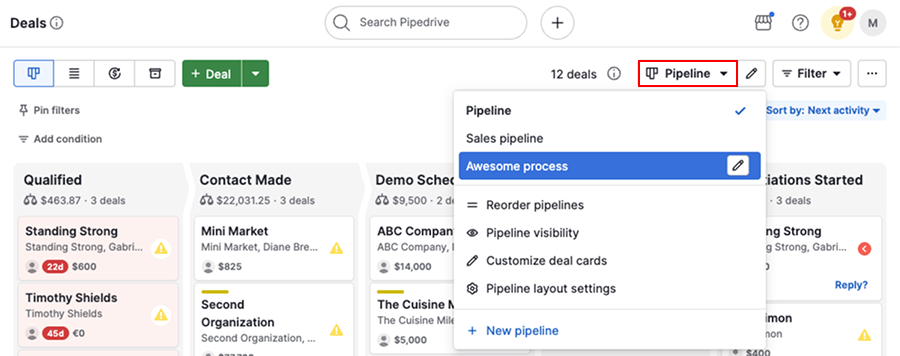
Pipedrive keeps the deal pipeline and your sequences in one place, and its automation builder covers most nurture workflows without much fuss. LeadBooster handles inbound capture, the starting price is low enough for small teams, and it plugs into Slack, Zapier, and Make natively. The limits show up on outbound at volume: there is no inbox rotation or real deliverability tooling, the Email Campaigns add-on costs extra, sequence logic is shallow next to Apollo, and there is no native A/B testing.
Highlights
- Pipeline plus sequences in one tool
- Low entry price, easy for small teams

Apollo Top pick
Apollo bundles a 275M-plus contact database, Mailbox Hub with built-in warmup and inbox rotation, multi-step sequences with A/B testing, AI-assisted writing with intent signals, and a native dialer plus LinkedIn steps. The tradeoffs: its CRM is lightweight rather than a Pipedrive replacement, data accuracy varies by industry and region, costs climb as you add seats and export credits, and deliverability still trails specialists like Smartlead at very high volume.
Highlights
- 275M+ contacts plus Mailbox Hub warmup
- Multi-step sequences with A/B testing
How to choose between Pipedrive and Apollo
The core question is whether your outbound motion is CRM-driven or sequence-driven. Pipedrive was built around the pipeline view. Every feature radiates out from the deal. That is a genuine strength when your reps are managing 30 to 50 active accounts, following up after demos, and sending targeted touches at the right pipeline stage. For an early-stage SaaS team, the entire outbound motion can live inside Pipedrive workflows and email templates and work cleanly, because the volume is low and the context is high.
Apollo flips the model entirely. It starts from a prospecting list and builds the sequence outward. The CRM layer exists to prevent you from needing a second tool, not to replace a proper pipeline. Where Apollo earns its cost is when you have a dedicated SDR function, you are sourcing net-new contacts at scale, and you need inbox rotation, per-mailbox sending limits, and deliverability monitoring baked in rather than bolted on. The Apollo docs on Mailbox Hub are worth reading carefully if you are evaluating their deliverability story.
Stay on Pipedrive if: Your reps work a defined account list, sequence volume stays under roughly 300 emails per day per rep, and the deal pipeline is the center of gravity for your team. Pipedrive’s automation builder handles stage-based triggers, task creation, and templated follow-ups without much fuss. Pair it with Clay for enrichment, push records into Pipedrive via Zapier or Make, and you cover most gaps without adding Apollo’s complexity or cost.
Move to Apollo if: You have SDRs sourcing cold lists, you need inbox rotation to protect domain reputation, or your team runs multi-channel sequences mixing email, LinkedIn, and calls. Also consider Apollo if you are paying a separate data provider and want to consolidate. The G2 comparison data on Apollo vs Pipedrive reflects this cleanly: Apollo wins on outbound execution features, Pipedrive wins on pipeline management.
The hybrid play: This is what I see most often through my work at Homegrown Growth Co. AEs own Pipedrive for pipeline. SDRs run Apollo for cold prospecting and hand off to Pipedrive at the “qualified” stage via a CRM sync or a Zapier trigger. More overhead to maintain, but each tool does the job it was actually designed for.
The deliverability gap is real, and it matters more in 2026
Deliverability is where the comparison stops being close. Pipedrive sends email through your connected Gmail or Outlook account with no inbox rotation, no warmup management, and no per-mailbox send-limit guardrails. Fine for low-volume follow-up. A liability for cold outbound. A common failure is burning a domain within weeks by running high-volume cold email through a single Pipedrive-connected inbox. It is not a hypothetical risk.
Apollo’s Mailbox Hub, even if it falls short of Smartlead or Lemlist for dedicated cold email infrastructure, manages warmup pools, rotates across connected inboxes, and surfaces deliverability signals before your domain reputation craters. The Litmus 2025 State of Email report makes clear that inbox placement is getting harder as providers tighten filters, which makes active sending-health monitoring more than a nice-to-have. For any team sending more than 100 cold emails per day, that infrastructure alone justifies Apollo’s price premium over Pipedrive’s add-ons.
My recommendation, stated plainly: Pipedrive is a better CRM than Apollo. Apollo is a better outbound execution platform than Pipedrive. The best stacks in 2026 treat them as complementary. But if you can only afford one and your primary motion is cold outbound at volume, Apollo owns that job more completely. Stop agonizing over the overlap and pick based on where your team actually spends its time.
Where Apollo sits in the wider data stack
If this comparison surfaced a different question, where Apollo stands as a data source rather than a sequencer, other posts here cover that from several angles. Lusha vs Apollo vs ZoomInfo covers the raw contact-data matchup, Cognism vs Apollo vs Lusha settles the European-outbound version, and Apollo vs Clay vs LinkedIn Sales Navigator looks at Apollo as a prospecting layer. Teams keeping HubSpot in the picture should read Apollo sequences vs HubSpot sequences before committing either way.
Frequently asked questions
Can Pipedrive replace Apollo for cold email outreach?
Pipedrive's Campaigns and automation cover warm outbound well, but it lacks Apollo's dedicated sequencing, inbox rotation, and deliverability infrastructure for true cold email at volume.
Does Apollo have a built-in CRM?
Apollo includes a lightweight CRM, but most teams use it alongside Salesforce or HubSpot rather than as a primary deal pipeline.
Which tool is better for small sales teams doing outbound?
Teams under 5 reps who already use Pipedrive as their CRM and send fewer than 500 cold emails per month can usually stay inside Pipedrive. Larger volumes or dedicated SDR functions push you toward Apollo.
Is Apollo good for email deliverability?
Apollo has improved significantly with Mailbox Hub and built-in warmup tools, making it a credible choice for cold outbound, though specialist tools like Smartlead still outperform it for high-volume sending.
What does Apollo cost compared to Pipedrive?
Apollo's paid plans start around $49 per user per month, while Pipedrive starts at $14 per user per month, though comparable feature tiers land closer to $49-$99 each.