GuidesIntent
Vector + n8n Website Visitor Signal Workflow
Build a website visitor intent workflow with Vector and n8n. Turn anonymous traffic into enriched, routed leads automatically. Step-by-step playbook.

The tools compared
Entry prices from the pricing index, read Aug 12, 2026
Some links on this page are affiliate links. If you buy through them we may earn a commission at no cost to you; it never changes a verdict. How we make money
The short answer
Use Vector to identify and score website visitors, pipe the signal into n8n, enrich with Clay, and route hot accounts to your CRM or sequencer in under 30 minutes of build time.
Most website visitor intent tools hand you a CSV on Monday morning and call it a workflow. You get a list of companies, no contact data, no routing logic, and no way to act on it before the window closes. I’ve watched teams burn real pipeline on exactly this setup. The fix is wiring a real-time signal from Vector into n8n so the moment a target account hits your pricing page, the right rep gets a Slack ping with enriched context, not a spreadsheet two days later.
This post is the first detailed build tutorial for Vector’s webhook output. There are no official workflow examples yet, so I’m documenting the exact steps my team uses for outbound-heavy B2B SaaS GTM motions.
Why this stack, and why now
Website visitor identification has been a category for years. The tooling just caught up to the automation use case. RB2B is excellent for LinkedIn-identified individual visitors and I still recommend it for founder-led outbound. But RB2B’s output is email-first and not designed to be a real-time automation trigger. Vector takes a different angle: it scores accounts by behavior across your site, assigns intent tiers, and exposes that signal as a structured webhook payload you can act on immediately.
The gap I keep hitting is that visitor intent tools generate noise without a filter layer. A mid-market ICP account hitting your docs once is not the same signal as an enterprise account that visited pricing, the integration page, and your security whitepaper in one session. Vector’s scoring model handles that differentiation. n8n is the right orchestration layer here because you need conditional branching (ICP check, score threshold, existing CRM contact check) before you write anything downstream. Zapier can do a linear chain. n8n can do a real decision tree. That distinction matters more than most people admit before they’ve hit Zapier’s filter limits at 3am.
Building the workflow step by step
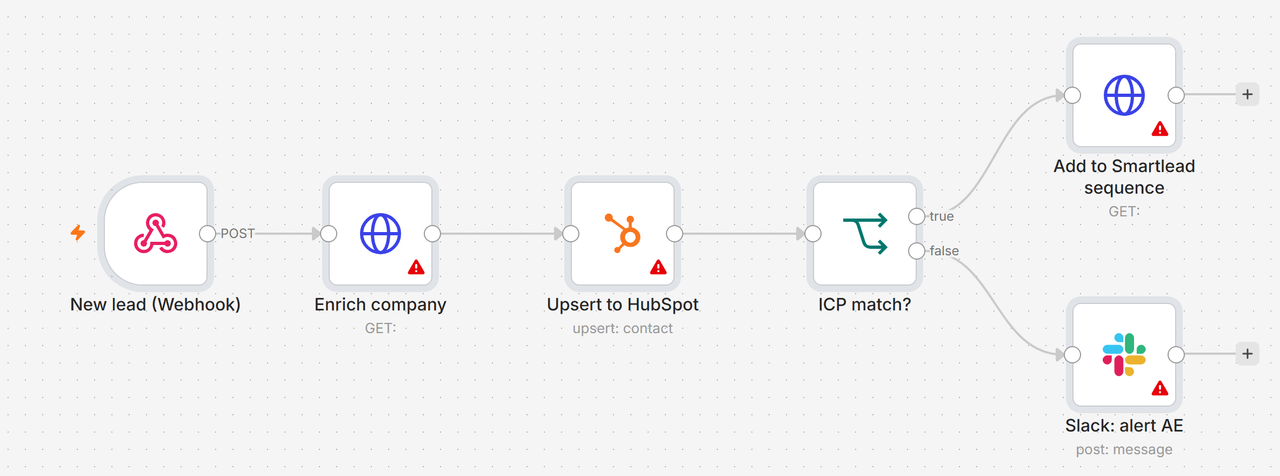
The workflow has four logical stages: capture the Vector signal, enrich the account and contact, apply ICP filters, and route to the right destination. Here’s how to build each one in n8n.
In n8n, add a Webhook node set to POST, leave authentication on None for now (you'll add header auth in production), and copy the test URL. This is the endpoint Vector will POST visitor events to. Keep the workflow in test mode so you can see the raw payload before building downstream nodes.
In Vector, go to Integrations > Webhooks and paste your n8n URL. Set the trigger to 'Intent Score Changed' and choose the minimum score threshold you care about (I default to 70 out of 100 for most setups). Check the boxes for company domain, visitor page path, session count, and the intent tier label. Save and trigger a test visit to confirm the payload arrives in n8n's execution log.
Use an n8n IF node to check the company domain against your ICP criteria from the Vector payload. At minimum: employee count range (Vector passes firmographic data from its own enrichment), industry code, and geography. Route non-ICP matches to a 'log and discard' branch that writes to a Google Sheet for periodic review. Only ICP-matching signals proceed to enrichment. This single step cuts your Clay credit spend by 60-80 percent.
Clay doesn't have a native n8n node, but its API is clean. Add an HTTP Request node, set method to POST, and point it at Clay's table webhook ingest URL. Pass the company domain and any contact signals Vector surfaced. Clay runs its waterfall enrichment (Clearbit, Apollo, LinkedIn, etc.) and returns verified email, phone, LinkedIn URL, and tech stack. This is the same pattern covered in the guide on [connecting Clay to n8n for automated enrichment](/blog/2026-07-31-connect-clay-to-n8n-for-a-fully-automated-enrichment-pipelin/). If you have not set that up yet, do it before this step.
Add a Switch node after Clay returns. Branch on your routing logic: existing CRM contact goes to an 'update and alert' branch (PATCH the HubSpot or Salesforce record, Slack the owner); net new contact matching a high-intent signal goes to your sequencer (Smartlead or Instantly node); below-threshold or unmatched goes to the review sheet. Every branch should write a 'visitor_intent_source: vector' property to whatever record it touches so you can track pipeline attribution later.
The trap: Vector’s webhook fires on every score change, including downward movements when a visitor’s session score decays. If you don’t filter for score direction, your workflow triggers on cold events and spams reps with stale alerts. This can burn a Slack channel’s credibility within days. Also watch for the same domain triggering multiple times in one session. Add a deduplication node (n8n’s built-in Deduplicate Items node works fine) keyed on domain plus a 4-hour window.
// Vector webhook payload (example)
{
  "event": "intent_score_changed",
  "direction": "up",
  "company": {
    "domain": "acmecorp.com",
    "name": "Acme Corp",
    "employees": 320,
    "industry": "SaaS"
  },
  "session": {
    "pages_visited": ["/pricing", "/integrations"],
    "session_count": 4,
    "intent_score": 84,
    "intent_tier": "hot"
  },
  "timestamp": "2026-08-01T14:22:11Z"
}
Which visitor intent tool fits your motion
This workflow is built on Vector, but I get asked constantly how it stacks up against RB2B and Warmly for different use cases. Here’s the honest answer. Don’t buy Warmly if you have a RevOps person who can run n8n. You’re paying for a managed product when the raw ingredients cost a fraction of the price.
Visitor Intent Tool by Use Case
Choose Vector if

- You want a real-time webhook trigger for automation workflows
- Account-level intent scoring matters more than individual identity
- You're running an n8n or Make orchestration layer and need structured payloads
Choose RB2B if

- You want LinkedIn profile-level identification of individual visitors
- Your outbound motion is founder-led or low-volume, high-touch
- Email-first alerts are fine and you don't need a webhook trigger
Choose Warmly if

- You want a full intent platform with built-in AI chat and rep alerts in one tool
- You prefer a managed product over a self-serve automation build
- Your team won't maintain custom n8n workflows
Production hardening before you go live
A workflow that runs clean in test and breaks in production is worse than no workflow. Reps start trusting the alerts, then stop, and you spend three weeks rebuilding credibility. Three things I always do before flipping a visitor intent workflow to live.
First, set header-based auth on the n8n webhook. Add a secret in Vector’s webhook config and validate it in an n8n Function node before any processing runs. Second, add an error branch on the Clay HTTP node that catches 4xx and 5xx responses and writes failures to a monitoring sheet. Third, cap Slack notifications at one alert per domain per 24-hour window using n8n’s workflow static data as a simple in-memory store.
This is the same hygiene I apply to the demo scheduling automation with Cal.com, HubSpot, and n8n that I’ve documented elsewhere. Real-time workflows without rate limiting and error handling are time bombs. Simple as that.
The workflow is the moat
The dirty secret of website visitor intent: every competitor in your space has access to the same identification technology. The edge is not the data. It’s the speed and precision of what you do with it. A Clay enrichment waterfall that verifies contacts before they hit your sequencer, an ICP gate that keeps reps focused on real signals, and a 90-second end-to-end latency from page visit to personalized outreach are not features any tool ships out of the box. They’re things you build. This Vector and n8n stack is the fastest path to building them correctly, and teams running it have seen reply rates on intent-triggered sequences land consistently above 15 percent compared to 4-5 percent on cold lists pulled from the same accounts.
Sources
Frequently asked questions
What is Vector used for in sales automation?
Vector is a website visitor identification and intent tool that de-anonymizes traffic, scores accounts by behavior, and surfaces buying signals for outbound teams.
Can n8n connect to Vector?
Vector exposes a webhook output you can point directly at an n8n webhook trigger node, making native integration straightforward without a middleware connector.
How is Vector different from RB2B?
RB2B focuses on identifying individual LinkedIn profiles visiting your site, while Vector layers account-level scoring and intent signals on top of visitor identification.
Do I need Clay to run this workflow?
Clay is optional but strongly recommended. It waterfall-enriches the company and contact data Vector surfaces before you write anything to your CRM or sequencer.
What CRMs and sequencers does this workflow support?
The n8n workflow can route to HubSpot, Salesforce, Outreach, Smartlead, or Instantly depending on which node you attach at the end of the pipeline.