Your HubSpot Chatbot Is Losing Inbound Leads: Fix It
 By Ian Chamberland 10 min read
 TL;DR
HubSpot chatbot gaps cost you inbound leads because it has no real-time visitor identification or smart routing. Adding Warmly for de-anonymization and n8n for orchestration closes that gap without replacing your CRM.
On this page
Here is the scenario I see constantly: a B2B team burns real budget driving traffic to their site, installs HubSpot’s chatbot widget, then watches session recordings where visitors hit the pricing page, sit there for 45 seconds, and leave without triggering a single conversation. The chatbot fired. Nobody responded. The visitor was never identified. Lead gone.
HubSpot is a solid CRM and a capable marketing automation platform. But its native live chat and chatbot tooling has a structural blind spot: it only personalizes for contacts it already recognizes. Anonymous visitors, which is most of your traffic, get zero real-time signal treatment. This post walks through the exact stack I use to fix that. Warmly handles real-time identification, n8n is the orchestration backbone, RB2B adds person-level de-anonymization, and Fillout captures high-intent form submissions with actual qualification data.
Why HubSpot’s Chatbot Falls Short for Real-Time Inbound
HubSpot’s chatbot is a known-contact tool pretending to be a real-time buyer signal tool. The gap between those two jobs is where your pipeline leaks.
I’ve audited HubSpot chat setups for B2B SaaS teams where the chatbot was technically live and technically firing. Here’s the problem: “firing” for HubSpot means displaying the widget. It does not mean identifying who is on the page, scoring their intent against your ICP, or routing them to the right rep in real time. If the visitor is not already a cookie-matched contact in your CRM, the bot treats them like any random anonymous human. No firmographic context. No account match. No urgency signal passed to sales.
The fix is not to rip out HubSpot. Build an identification and routing layer upstream of it, then let HubSpot do what it is actually good at: sequencing, task creation, and deal management.
The Stack: How Warmly, n8n, RB2B, and Fillout Work Together
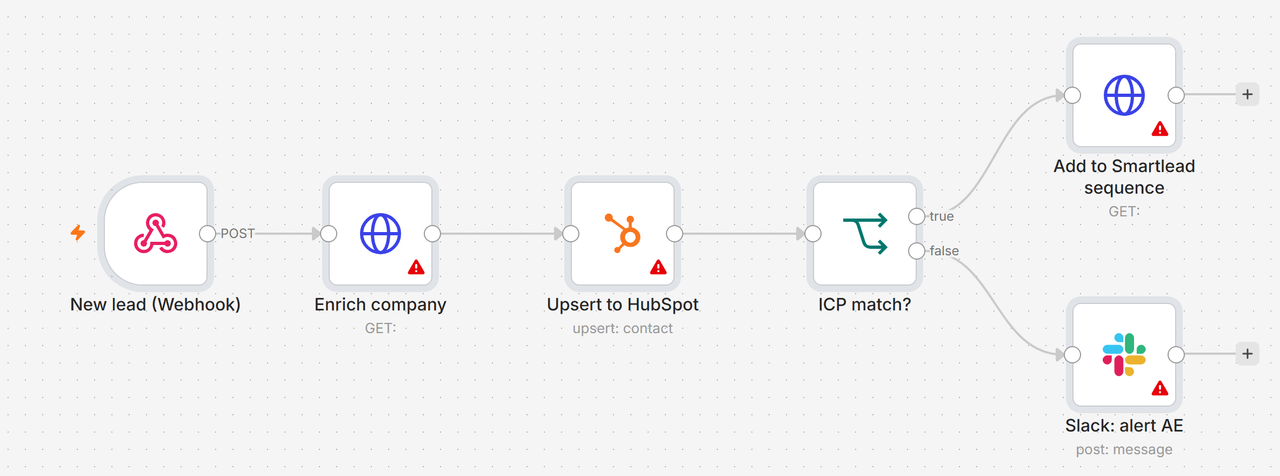
The architecture is simpler than it sounds. Warmly sits on your site as a pixel and uses IP-to-company resolution plus intent signals to identify which accounts are active right now. RB2B adds person-level resolution for US visitors, pushing LinkedIn profile data (name, title, LinkedIn URL) via webhook in near real time. Fillout handles high-intent micro-conversions where a visitor opts in but you want richer qualification data than a standard HubSpot form collects. n8n is the glue: it receives all of these signals, applies routing logic, and writes back to HubSpot with full context.
Both are async JavaScript snippets. Load them in your site's <head> via Google Tag Manager or hardcoded. Warmly fires company-level intent signals within seconds of a page load. RB2B fires a person-level webhook when it matches a US visitor to a LinkedIn profile. They do not conflict; they are complementary layers.
In n8n, spin up two webhook trigger nodes: one for Warmly's visitor event payload (account name, domain, page URL, intent score, time on page) and one for RB2B's person payload (first name, last name, LinkedIn URL, email when available). Set both to POST, copy the URLs into each tool's webhook configuration.
After each webhook trigger, add an IF node. For Warmly signals, branch on: is the company domain in your target account list, is the page visited a high-intent page (pricing, demo request, comparison), and has this domain been seen fewer than 3 times this week (to avoid rep fatigue on serial browsers). For RB2B signals, branch on job title matching your buyer persona keywords.
When the ICP branch is true, use n8n's HubSpot node to search for an existing contact by email or company domain. If found, update the contact record with a custom property like 'Last real-time intent page' and 'Intent signal date.' If not found, create a new contact with source set to 'Warmly / RB2B real-time.' This is your enriched inbound lead, not a cold shell.
Simultaneously, post to your SDR Slack channel with the visitor's company, page, and (if from RB2B) the person's LinkedIn URL. Then use the HubSpot API via n8n to enroll the contact in a targeted sequence. For Fillout form submissions with richer answers, parse the response fields in n8n first, then route to the correct sequence based on qualification tier.
The trap: HubSpot deduplication conflicts
If you create contacts in HubSpot via API without a verified email, you will end up with ghost records that break your merge logic later. Warmly often resolves to domain only; RB2B resolves to a LinkedIn URL that may or may not match an existing email in your CRM. I’ve seen this produce three duplicate records for the same buyer because each signal created a new contact. Always search before you create.
// n8n Function node: safe HubSpot upsert logic
const email = $input.item.json.email || null;
const domain = $input.item.json.domain;

if (email) {
  // Search by email first (highest confidence)
  return [{ json: { searchBy: 'email', value: email } }];
} else {
  // Fall back to domain search, flag as unverified
  return [{
    json: {
      searchBy: 'domain',
      value: domain,
      contactProperties: {
        email_confidence: 'domain_only',
        lead_source_detail: 'warmly_anonymous'
      }
    }
  }];
}
Where Fillout Plugs the Form Gap
HubSpot’s native forms are fine for top-of-funnel volume. Where they fall apart is conditional routing and multi-step qualification flows. Fillout lets you build branching forms where the next question depends on the previous answer, and it sends a structured JSON payload to an n8n webhook on submission. This matters when your “Book a Demo” CTA attracts a mix of SMB, mid-market, and enterprise visitors who all need different next steps. A single HubSpot form cannot tell them apart.
The practical setup: replace your HubSpot embedded demo request form with a Fillout form that asks two or three qualification questions (company size, use case, current tool stack). Pipe the Fillout webhook into the same n8n workflow, branch on qualification tier, and enroll contacts in tier-specific HubSpot sequences rather than one generic nurture. In my testing, reps respond faster and convert better when their Slack alert already tells them what the prospect said their problem is, not just that someone filled out a form.
Don’t bother building this routing logic inside HubSpot’s workflow editor. It gets unwieldy fast and you lose visibility. Keep the branching in n8n where you can see the whole graph.
If you are already thinking about connecting HubSpot with real-time communication tools for alerts, the same n8n pattern from our Aircall-to-HubSpot workflow post applies here: webhook in, enrich in n8n, write to HubSpot, alert in Slack.
Choosing the Right Layer for Your Situation
Which piece of this stack do you need most right now?
Choose Warmly if

- You get decent site traffic but your SDRs have no idea which target accounts are visiting
- You want company-level intent signals without building a full data pipeline
- You need a visual interface showing live visitors your reps can act on directly
Choose RB2B if

- Your buyers are US-based individuals and you want person-level LinkedIn identity, not just company name
- You are comfortable piping a webhook into n8n and want the cheapest possible ID layer
- You already have Warmly or a similar tool and want to add a personal-identity layer on top
Choose n8n if

- You want full routing logic ownership without paying per-task fees that compound at scale
- You are comfortable with a low-code workflow canvas and occasional JavaScript function nodes
- You need one orchestration layer that connects Warmly, RB2B, Fillout, HubSpot, and Slack under one roof
Choose Fillout if
- Your HubSpot forms treat every submission the same regardless of company size or use case
- You want conditional branching and multi-step qualification without building a custom form
- You need webhook output that n8n can parse and route without manual field mapping every time
One Workflow, Real Pipeline
The full stack in production looks like this: Warmly or RB2B fires a webhook when a target account hits a high-intent page. n8n receives it, checks your HubSpot CRM for an existing contact, creates or updates the record with intent context, posts a Slack alert to the owning SDR, and optionally enrolls the contact in a HubSpot sequence matched to their stage. Fillout handles the cases where a visitor self-identifies through a form, adding qualification data that makes the n8n routing smarter downstream.
Nothing about this requires replacing HubSpot. It requires accepting that HubSpot’s chatbot is a response tool, not a detection tool, and building detection upstream.
According to HubSpot’s own research on lead response time, the window to convert an inbound lead is measured in minutes. The chatbot sitting idle while an anonymous ICP visitor bounces is not a chatbot problem. It is a signal problem. This stack solves it.
Sources
Frequently asked questions
Is Warmly a HubSpot alternative for real-time feedback on site visitors?
Yes. Warmly identifies anonymous site visitors in real time and surfaces firmographic and intent data that HubSpot's native chatbot cannot provide on its own.
Can n8n connect Warmly to HubSpot automatically?
Yes. n8n can webhook Warmly visitor signals, enrich them via RB2B or Fillout form data, then create or update HubSpot contacts and trigger sequences without manual intervention.
What does HubSpot chatbot lack compared to Warmly?
HubSpot's chatbot has no native IP-to-company resolution or real-time intent scoring. It can only personalize conversations for contacts already in your CRM.
How does RB2B fit into this inbound stack?
RB2B de-anonymizes US-based site visitors at the individual level and pushes LinkedIn profile data via webhook, giving n8n a person-level signal to enrich before HubSpot contact creation.
Do I need to replace HubSpot to get real-time visitor feedback?
No. This stack keeps HubSpot as the CRM and engagement layer. Warmly and n8n sit upstream to feed it higher-quality, real-time identified leads.
Free Newsletter
Get new posts by email.
Migration guides, tool comparisons, and pricing breakdowns from real RevOps and GTM stacks, sent as they publish.
No spam. Unsubscribe anytime.
Enjoying this? Share it with your team.
Keep reading
Some links are affiliate links. Disclosure.