GuidesReview
Signal House Review 2026: Honest Take for GTM Teams
Signal House reviewed for revenue and GTM teams in 2026. Covers calling intelligence, conversation AI, and how it stacks up against Gong, Chorus, and Fireflies.

The tools compared
Entry prices from the pricing index, read Aug 12, 2026
Some links on this page are affiliate links. If you buy through them we may earn a commission at no cost to you; it never changes a verdict. How we make money
The short answer
Signal House is a calling and conversation intelligence platform worth evaluating if you want revenue signals surfaced from calls without paying Gong-tier prices, but it is still maturing on CRM integrations.
Most conversation intelligence reviews are just Gong versus Chorus with a price table stapled on. Signal House is newer, less hyped, and occupies an interesting position: affordable enough for a 10-rep team, capable enough to surface the revenue signals that actually change pipeline decisions. My read, after going deep on the product, positioning, and where it lands against alternatives like Gong, Fireflies, and Fathom, is that it deserves a serious look from GTM operators who are tired of paying enterprise prices for features they use maybe 30% of the time.
What Signal House Actually Does
Signal House is not a standalone dialer and not a pure notetaker. It sits at the intersection of calling infrastructure and conversation intelligence, which is a harder product to build than either alone. The pitch: make the call, get the transcript, surface the signals that matter to pipeline, and push structured data back to your CRM. That is the same pitch as Gong at ten times the price, and roughly the same as Fireflies with a dialer included.
The AI layer is where I pay attention. Transcription is table stakes in 2026. Every tool from Otter to Fathom to Avoma gets transcription right enough. The real question is what the platform does with the text afterward. Signal House focuses on revenue signals: deal risk, buying intent phrases, competitor mentions, and next-step commitments made on the call. Per the vendor documentation, these signals feed into a deal dashboard meant to inform pipeline reviews rather than just archive recordings. That framing matters because it changes who in the GTM org actually uses the output. Not just AEs and managers, but RevOps pulling deal health signals into their forecasting workflow.
Feature Breakdown
Signal House: What You Get

Calling Infrastructure
Signal House includes a cloud-based dialer so reps do not need a separate Kixie or Aircall subscription to get call recording. For teams running pure outbound, this is a real cost consolidation. The dialer supports local presence and call routing per the vendor feature page. My read: if you are already paying for a dedicated dialer, the bundle makes the per-seat math worth a serious look.
Highlights
- Built-in cloud dialer with local presence
- Call routing and queue management
- No third-party dialer required for most use cases
Conversation Intelligence
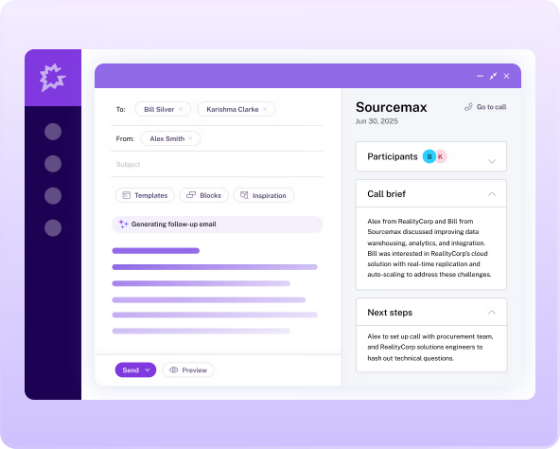
Transcription runs automatically post-call. The AI layer flags competitor mentions, objection patterns, buying signals, and next-step commitments. This is where Signal House earns its place in a RevOps stack rather than just the sales enablement shelf. The output is structured, which means it can feed into HubSpot deal properties or Salesforce fields rather than living as a PDF summary nobody opens.
Highlights
- Automatic transcription with speaker diarization
- Revenue signal extraction (risk, intent, objections)
- Competitor mention tracking
- Commitment and next-step detection
CRM Integration
The HubSpot integration pushes call recordings, transcripts, and signal tags directly to contact and deal records. Per G2 reviewer notes, the HubSpot sync is reliable and maps cleanly. The Salesforce connection works, but reviewers flag occasional sync lag and less granular field mapping compared to a dedicated tool like Gong or Chorus. For HubSpot-native stacks, this is a non-issue.
Highlights
- HubSpot: call logs, transcripts, signal tags to deal records
- Salesforce: call logging with some field mapping limitations
- Webhook support for custom CRM pushes
Pipeline and Coaching Dashboards
Managers get a dashboard showing deal risk scores by account, talk-to-listen ratios by rep, and objection frequency across the team. This is the output RevOps actually needs to run a structured pipeline review without manually pulling call clips. I would compare this to what Avoma or tl;dv offer, but with the dialer data included so you get a fuller picture of call volume alongside call quality.
Highlights
- Deal risk dashboard by account
- Talk-to-listen ratio by rep
- Objection and competitor mention frequency
- Call scoring for coaching queues
How Signal House Fits Into a Real GTM Stack
The usual failure mode with conversation intelligence tools: sales leadership buys them, recordings pile up, and nobody has a workflow to act on the data. Signal House’s signals layer is an attempt to break that pattern by making the output structured and CRM-native rather than a searchable archive. That matters for RevOps because it connects call data to the objects the team already uses, deals, contacts, pipeline stages.
In a HubSpot-native stack, the workflow I would design looks like this. Signal House triggers on call completion, pushes the transcript and signal tags to the deal record, and a HubSpot workflow fires when a competitor mention flag appears, alerting the AE’s manager via Slack. That loop closes within minutes of the call ending. You do not need a separate tool like n8n or Zapier for basic versions of this because the native integration handles it. For more complex branching logic, I would lean on n8n to avoid HubSpot workflow limits.
For teams already running Gong or Outreach, Signal House is not a drop-in replacement at the enterprise tier. Gong’s dataset for benchmarking talk tracks against top performers is genuinely hard to replicate, and Outreach’s sequence-to-call feedback loop is more mature. But for a 10 to 25 rep team that does not need that depth, Signal House is the conversation I would have first.
The conversation intelligence category has also become crowded with notetaker-only tools like Fathom, Laxis, and Circleback. Signal House’s differentiator is the dialer bundled with the intelligence layer. Evaluating a pure notetaker for an existing dialer stack? Those standalone tools may be sufficient. Want a single platform that handles calling and intelligence? Signal House is one of the shorter lists worth considering.
How to Choose: Signal House vs. the Alternatives
Which conversation intelligence tool fits your team?
Choose Signal House if
- Your team is 5 to 30 reps and Gong's contract size is not justified yet
- You want calling and conversation intelligence from one vendor, not two subscriptions
- Your CRM is HubSpot and you want deal-level signal data without custom middleware
Choose Gong if

- You have 30-plus reps and need cross-team benchmarking against industry norms
- Your RevOps team runs forecasting from call data and needs the full Gong Forecast layer
- You are on Salesforce and need deep, battle-tested field mapping
Choose Fireflies if
- You already have a dialer and just need a lightweight notetaker with decent search
- Budget is the primary constraint and you can live with a free or very low-cost plan
- You do not need revenue signals, just accurate transcripts and meeting summaries
Choose Fathom if

- Your team runs mostly video calls and needs Zoom or Meet notetaking only
- Individual reps want a personal productivity tool without team admin overhead
- You are not ready to connect call data to your CRM in a structured way
The Bottom Line
Signal House earns a place on the evaluation shortlist for SMB and mid-market GTM teams who want structured call intelligence, a bundled dialer, and CRM-native signal pushing without the enterprise price tag. It is not the right call for a 50-rep org that needs Gong’s benchmarking depth or Outreach’s sequence feedback loop. For a HubSpot-native team in that 5 to 30 rep range, though, it is a credible alternative worth putting in front of any conversation intelligence RFP before defaulting to the obvious names. The first thing I would check is whether the deal risk signals actually map to your pipeline stages in HubSpot, because that is where the value either compounds or gets lost in a generic dashboard nobody opens.
Sources
Frequently asked questions
What is Signal House?
Signal House is a conversation intelligence and calling platform that records, transcribes, and analyzes sales calls to surface revenue signals. It sits in the same category as Gong, Chorus, and Fireflies.
How does Signal House compare to Gong?
Signal House is significantly cheaper than Gong and targets smaller GTM teams. Gong has deeper CRM integrations and a larger dataset for benchmarking, but Signal House trades that enterprise depth for simpler setup and lower seat cost.
Does Signal House integrate with HubSpot or Salesforce?
Signal House offers native integrations with HubSpot and Salesforce for call logging and deal updates, though reviewer feedback suggests the Salesforce sync is less mature than the HubSpot connection.
Who is Signal House best for?
Signal House fits best for SMB and mid-market GTM teams of 5 to 30 reps who want conversation intelligence and revenue signals without committing to Gong or Outreach-level contracts.
Is there a free trial for Signal House?
Per the vendor site, Signal House offers a trial period before requiring a paid commitment. Check their current pricing page for exact trial length, as terms can change.