GuidesTool vs tool
Instantly vs Clay vs Apollo: Lead Gen ROI Compared
Which tool wins on lead gen ROI when you factor in enrichment costs, domain flagging, and real reply rates? A RevOps breakdown of Instantly, Clay, and Apollo.

The tools compared
Entry prices from the pricing index, read Aug 12, 2026
Some links on this page are affiliate links. If you buy through them we may earn a commission at no cost to you; it never changes a verdict. How we make money
The short answer
Instantly wins on deliverability and domain resilience, Clay wins on enrichment depth and signal quality, and Apollo wins on CRM-native simplicity, so the right choice depends on where your pipeline bleeds most.
Most outbound ROI conversations focus on the wrong variable. Teams obsess over reply rate benchmarks and ignore the two costs that actually eat margin: bad data and flagged domains. When you buy a list from Apollo at scale, enrich it through Clay, and send through Instantly, each layer carries its own tax. That tax compounds. This post is about understanding where each tool wins and loses when you do the full-stack math, not just compare feature checkboxes.
Where each tool actually earns its keep
The usual mistake is treating these three as interchangeable “outbound platforms.” They are not. They operate at different layers of the pipeline and have almost nothing to do with each other under the hood.
Instantly is fundamentally an email infrastructure product that grew a sequencer on top. Its core value is deliverability: domain rotation across hundreds of sending accounts, Warmup Pool with over 500,000 inboxes, and built-in bounce and spam signal monitoring. When a domain starts flagging, Instantly can route sends through a clean domain automatically. No other tool in this comparison does that natively. If your team sends at volume (say, 2,000-plus emails per day), deliverability infrastructure is not optional, and Apollo’s native sequences simply cannot match what Instantly provides here.
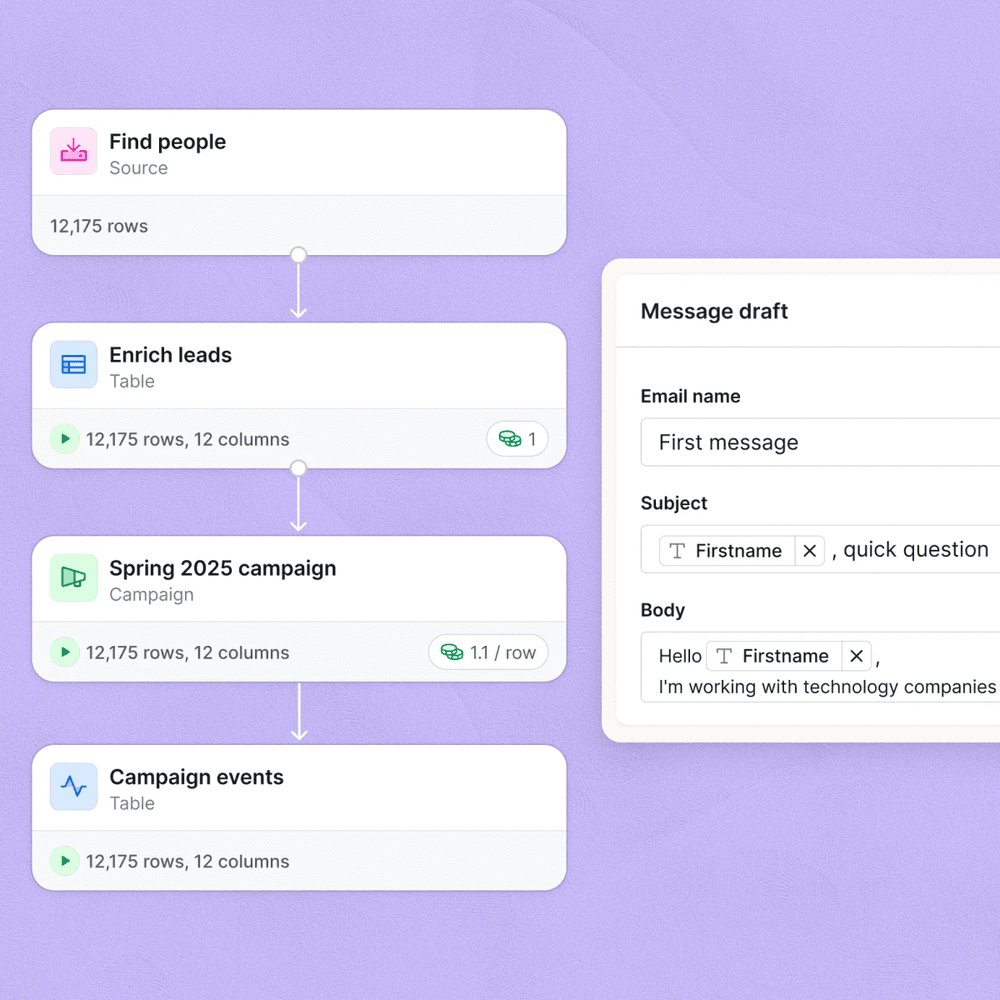
Clay earns its keep one layer earlier: data quality before anything hits a mailbox. Its waterfall enrichment logic tries the cheapest provider first, escalates to premium providers only when lower-tier attempts fail, and charges per successful match rather than per lookup attempt. That matters a lot when you’re enriching a 10,000-row list. A naive Apollo export might give you 60-70% valid emails. The same list run through Clay’s waterfall, pulling from providers like Prospeo, Findymail, and Hunter, can push that validation rate to 85-90% according to Clay’s own enrichment documentation. The gap in valid contacts is directly a reply rate multiplier. I’d argue data enrichment is where most outbound teams should invest before they touch copy or cadence.
Apollo earns its keep in a different scenario entirely: teams that want one login for prospecting, sequencing, and CRM activity sync. Apollo’s native Salesforce and HubSpot integrations are genuinely good. Contact activity, reply events, and sequence enrollment all log bidirectionally without a Zapier layer. For a 2-3 person sales team running 200-400 contacts per month, that integration simplicity is worth real money compared to wiring Clay plus Instantly plus a CRM sync manually. The cost of complexity is real, and Apollo eliminates it, at the expense of ceiling on deliverability and enrichment depth.
The domain flagging math no one runs
Here’s where the ROI conversation gets uncomfortable. Most teams track reply rate. Almost no one tracks domain health cost.
Say you run a 3,000-email-per-day outbound program across five sending domains. If even one domain hits Google’s 0.3% spam rate threshold, that domain gets throttled or blacklisted. You lose effective sending capacity on that domain permanently unless you rehab it over 60-90 days, which realistically means buying a new domain, warming it for 2-4 weeks, and absorbing the pipeline gap in between. At 3,000 emails per day, that’s 42,000 to 84,000 missed send slots during rehab. At even a 1% reply rate and a 15% close rate on replies, the revenue exposure from one burned domain is material.
Instantly’s architecture addresses this directly. Its domain rotation system distributes sends across pools of warmed domains, so no single domain absorbs enough volume to trigger a spam rate flag. Clay and Apollo have no equivalent infrastructure. Apollo’s sequences are good, but they send from your own domains without rotation or warming logic built in. If you care about deliverability at scale, that is a fundamental architectural gap.
This is also why I’d pair Instantly with MailReach or a similar deliverability monitoring tool as a second signal. Instantly’s warmup data is a leading indicator, but an external blacklist check catches problems Instantly’s own reporting might lag on.
Instantly vs Clay vs Apollo: Job-to-be-Done Matrix
| Instantly | Clay Top pick | Apollo | |
|---|---|---|---|
| Primary job | Email sending and deliverability | Data enrichment and lead research | Prospecting database plus sequences |
| Data freshness | No proprietary data | Aggregates 50-plus live providers | Proprietary DB, can lag on niche ICP |
| Domain resilience | Best in class, rotation built in | No sending layer | Single-domain sends, no rotation |
| CRM integration | Lightweight native CRM, sync via Zapier/Make | Push to CRM via webhooks or Clay tables | Native HubSpot and Salesforce sync |
| Enrichment cost | None | $0.01-$0.05 per successful match | Included in plan credits |
| Best for team size | 5-plus reps sending at volume | Any team enriching lists at scale | 1-5 reps, consolidated stack |
| Steepest learning curve | Domain setup and inbox rotation config | Waterfall logic and credit optimization | Sequence personalization at scale |
| Try Instantly → | Try Clay → | Try Apollo → |
Match each tool to the outbound job it actually does best
How to choose
The first question I’d ask any outbound team is: where does pipeline actually leak? If the answer is bad data (bounces above 5%, contacts without valid mobile or direct email), Clay is the highest-leverage investment before you touch anything else. If the answer is deliverability (open rates collapsing, reply rates flat even when copy improves), Instantly’s infrastructure is the fix. If the answer is tooling overhead and CRM sync friction, Apollo consolidates the stack at the cost of ceiling.
My read is that most teams above 10 reps sending at meaningful volume will eventually need Clay plus Instantly regardless of where they start. Apollo makes sense as a data source or for the CRM sync layer, but its sequences are not competitive at scale once deliverability becomes the constraint. For a comparison of how Apollo’s contact data stacks up against alternatives on raw API quality, that is worth reading before you commit to Apollo as your primary prospecting database. For teams earlier in their outbound journey, Apollo’s all-in-one simplicity is genuinely the right starting point. The usual failure is staying there past the point where the ceiling becomes the bottleneck.
Which tool fits your outbound situation?
Choose Instantly if

- You send more than 1,000 emails per day and domain health is a real concern
- You've had a domain flagged or blacklisted in the last 12 months
- You run multi-inbox rotation and need automated warmup at scale
Choose Clay if

- Your bounce rate is above 4% or your contact data feels stale
- You need enrichment signals beyond email: mobile, tech stack, job change triggers
- You're building personalized outbound at scale and need waterfall logic to cut enrichment cost
Choose Apollo if

- You have fewer than 5 reps and want one tool for prospecting, sequences, and CRM sync
- Your ICP is in Apollo's core B2B segments (SaaS, tech, services) where data freshness is reliable
- You can't justify separate tools for data, sending, and CRM yet
The stack that actually pencils out
For teams that want honest ROI math: a Clay-plus-Instantly stack with Apollo or another provider as the data source is where the numbers work at volume. Clay gets you to 85-plus percent valid contact data before anything hits a mailbox, per Clay’s waterfall enrichment documentation. Instantly keeps your domains healthy and your sends landing in primary tabs rather than spam. Apollo, used narrowly as a prospecting database with its native CRM sync doing the heavy lifting, earns its seat at the table without duplicating the sequencing and deliverability work the other two handle better.
If you’re also evaluating how cold email ROI compares across other sending platforms, that context is worth stacking against what Instantly offers before you finalize anything.
Sources
Frequently asked questions
Is Instantly better than Apollo for cold email?
Instantly is better for high-volume cold email deliverability thanks to its domain rotation and inbox warming infrastructure. Apollo is better if you need built-in CRM, contact data, and sequences in one platform.
Does Clay replace Apollo for prospecting?
Clay is a data enrichment and waterfall lookup tool, not a sequencer. It can pull data Apollo misses, but you still need a sending platform like Instantly or Smartlead to run outbound.
What is the real cost of using Clay for enrichment?
Clay credits cost roughly $0.01 to $0.05 per row depending on the provider, and a 10,000-contact enrichment run can easily cost $150 to $500 depending on waterfall depth and provider mix.
Does Instantly have CRM features?
Instantly has a lightweight built-in CRM added in 2024, but it is not a replacement for Salesforce or HubSpot. It is best used as a sending layer that syncs to your real CRM.
Which tool has the best data quality, Clay or Apollo?
Clay typically surfaces higher-quality data because it waterfalls across 50-plus enrichment providers and only charges per successful match. Apollo's proprietary database is faster but can lag on data freshness for niche segments.