GuidesRevOps
Why Your RevOps Stack Grows Too Fast in 2026
RevOps teams keep building 7-tool stacks when 4 would do. Here is why tool sprawl happens and a $400/mo teardown that actually holds together.

Some links on this page are affiliate links. If you buy through them we may earn a commission at no cost to you; it never changes a verdict. How we make money
The short answer
RevOps tool sprawl in 2026 is driven by point-solution buying pressure and fear of missing out on AI features, but most teams can run a tighter, cheaper stack built around HubSpot, Clay, n8n, and Lemlist for under $400 per month.
Every RevOps team I talk to arrives at the same confession about six months in: “We bought Apollo because sales wanted sequences, then Outreach because the AEs said Apollo was not enterprise enough, then ZoomInfo because the SDRs said Apollo data was bad, and now we are paying for three tools that all touch the same contact record.” That is not a budget problem. That is automation debt compounding in real time. In 2026 it is happening faster than ever, because every SaaS vendor is slapping an AI badge on a feature that already existed in the tool you are currently paying for.
The real cost of a bloated RevOps stack is not the SaaS invoices. It is the three hours per week your ops person spends debugging sync errors between tools that were never meant to talk to each other.
The Three Forces Pushing Stacks Past Their Limit
The first force is vendor-led expansion. Tools like HubSpot and Salesforce are aggressively bundling upward. Every quarter there is a new AI feature gated behind a higher tier, and your CSM’s motion is always “just upgrade.” The second force is rep-led buying. An SDR reads a cold email from Apollo or Smartlead, signs up for a trial, gets one small win, and goes to their manager with a screenshot. Before RevOps is in the room, there is a new line item on the company card. The third force is the AI FOMO cycle. In 2025 and 2026, every tool from Clay to Gong to Lemlist shipped AI writing, AI scoring, and AI “insights.” Teams buy the new thing without deprecating the old one.
Gartner research on SaaS sprawl has consistently shown that enterprises use less than half the licenses they purchase. I see the same pattern at companies with 20 reps. It is not an enterprise problem. It scales down.
The result is what I call automation debt: a stack where data fidelity degrades at every sync point, where your RevOps engineer spends 30 percent of their week in Zapier logs instead of building pipeline, and where nobody can honestly answer the question “where does this contact actually live?”
The Consolidation Pattern Nobody Talks About
Here is my contrarian take: the answer is not always fewer tools. It is fewer integration seams. A four-tool stack with bad data plumbing is worse than a six-tool stack with clean, unidirectional data flow. The goal is to reduce the number of places where a contact record gets written by more than one system without a source-of-truth rule. Most consultants will tell you to cut the tool count. My advice is to cut the bidirectional syncs first and see what shakes out.
The stack I keep coming back to for B2B SaaS teams under 15 reps: Clay for enrichment and list building, n8n for orchestration and routing, Lemlist for multichannel outreach, and HubSpot as the system of record. Four tools. One direction of data flow. No Zapier tax.
 enrichment table showing waterfall data lookups across multiple providers with fill rate indicators](/screenshots/clay-enrichment.png)
The $400/Mo Stack Teardown
Let me show the actual math on what this costs for a team running two SDRs and one RevOps person.
HubSpot Starter CRM Suite: $20/mo for the base, bumped to roughly $50 with two paid Sales Hub Starter seats. You are not getting sequences at this tier. That is fine. Lemlist owns that job. Use HubSpot purely as a contact and deal database with basic reporting. This is a deliberate constraint, and it is the right one.
Clay Starter: $149/mo, which gets you 2,000 credits per month. At roughly one credit per enrichment action, that covers a 500-lead/month outbound motion with waterfall lookups from Clearbit, Hunter, and People Data Labs without paying for any of those providers separately. Clay’s pricing page is transparent about the credit math, and it pencils out clearly against buying ZoomInfo or Apollo data as standalone subscriptions.
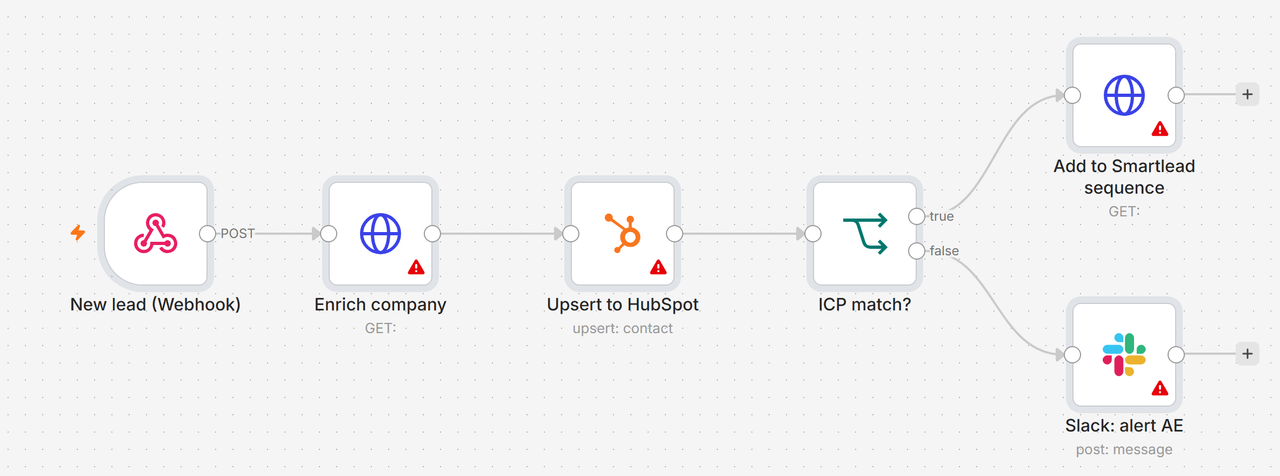
n8n Cloud: $50/mo on the Starter cloud plan, or free if you self-host on a $20/mo VPS. I default to cloud unless there’s an engineer on staff. This replaces Zapier entirely. The n8n canvas handles four jobs: pulling enriched records from Clay via webhook, scoring and routing with a simple ICP filter workflow, pushing clean records to HubSpot with deduplication logic, and triggering Lemlist sequences based on lifecycle stage. One canvas. No Zaps. No per-task pricing surprises at the end of the month.
Lemlist: $99/mo for one seat on the Email Pro plan. Multichannel sequences (email plus LinkedIn touchpoints), built-in email warm-up via Lemwarm included, deliverability managed from a single dashboard. For two SDRs, add another $99. Teams that try to run sequences out of HubSpot Starter often wonder why reply rates stay low. Dedicated sending infrastructure matters more than most people think.
Total: $398/mo for a two-SDR outbound motion with clean enrichment, smart routing, and proper deliverability. Most teams I audit are spending $900 to $1,400/mo on a seven-tool stack doing the same job with worse data fidelity.
Where This Stack Breaks (and What to Do About It)
No stack is perfect. These are the three friction points I see consistently, and how I handle them at Homegrown Growth Co.
The gotcha: Clay credits burn fast if your waterfall is misconfigured. A single row that waterfalls through six providers on a bad domain will eat 6 credits for zero return. New users routinely exhaust their credits in week two and assume Clay is broken.
The fix: Build your waterfall with a “stop on first hit” rule using Clay’s conditional column logic. Only proceed to the next provider if the previous one returned null. Start with Apollo Basic (cheapest), then Hunter, then People Data Labs. In practice, you will fill 70 to 80 percent of work emails on the first two steps alone.
// Clay waterfall column config (simplified)
{
  "column": "Work Email",
  "providers": [
    {
      "source": "Apollo Basic",
      "stop_if_found": true
    },
    {
      "source": "Hunter",
      "stop_if_found": true
    },
    {
      "source": "People Data Labs",
      "stop_if_found": true
    }
  ],
  "fallback": null
}
The second friction point is HubSpot’s contact limit at Starter. At 1,000 marketing contacts you hit the ceiling and the bill jumps hard. The fix is simple: keep HubSpot as a sales CRM only. Never flip contacts to “marketing” status unless they are being enrolled in an actual HubSpot campaign. All your Lemlist sends go through Lemlist, not HubSpot workflows. This keeps your contact count clean indefinitely. The HubSpot marketing contacts explainer covers this distinction well, and it is worth sending to whoever owns your portal before they accidentally enroll a list.
The third friction point is n8n’s learning curve. If your RevOps person has never written a JSON expression or built a conditional branch in a workflow tool, the first two weeks feel slow. My honest recommendation: spend one afternoon with the n8n docs on expressions and build the Clay-to-HubSpot deduplication workflow first. Once that clicks, the rest of the canvas logic follows quickly. Do not start with the Lemlist trigger. Start with the deduplication node. It teaches you how n8n thinks.
Automation Debt Is a Leadership Problem Before It Is a Tooling Problem
The real reason RevOps stacks bloat is that nobody owns the deprecation decision. Sales leaders buy tools. Marketing ops buys tools. RevOps inherits the integrations. Unless someone has an explicit mandate to sunset a tool when a new one covers the same job, you just accumulate. I tell every RevOps leader I work with to run a quarterly stack audit with one question per tool: “If we deleted this tomorrow, what would actually break?” If the answer is “someone’s habit,” that tool is a consolidation candidate. Not a maybe. A candidate.
The four-tool stack above works not because those four tools are uniquely perfect, but because the constraint forces clarity. You cannot use HubSpot as both your sending platform and your CRM without paying for Sales Hub Pro. You cannot rely on Zapier for high-volume enrichment routing without watching per-task costs climb past n8n’s flat monthly fee. The Salesforce State of Sales report consistently shows that top-performing sales teams standardize their tech rather than experiment with it. Constraint is a feature. Treat it like one.
Sources
Frequently asked questions
What is RevOps tool sprawl?
RevOps tool sprawl is when a go-to-market team accumulates more SaaS tools than necessary, often because tools were bought reactively to solve single problems without auditing what already existed in the stack.
How many tools does the average RevOps team use?
Most mid-market RevOps teams run 6 to 10 tools in their GTM stack, but research from Gartner shows that redundancy and underutilization are common above 4 to 5 core tools.
What does a lean RevOps stack cost per month?
A well-scoped 4-tool stack covering CRM, enrichment, automation, and outreach can run between $350 and $450 per month for a small team, depending on contact volume and seat count.
Can n8n replace Zapier and Make for RevOps workflows?
Yes, for teams comfortable with self-hosting or cloud deployment, n8n can replace both Zapier and Make at a fraction of the per-task cost, especially for high-volume enrichment and routing workflows.
Is Clay worth it for small RevOps teams?
Clay is worth it if you are running outbound at volume and need waterfall enrichment across multiple data providers. For teams running fewer than 500 new leads per month, the entry tier is probably sufficient.