GuidesTool vs tool
Relevance AI vs Lindy vs n8n: AI Agents for GTM Teams
Comparing Relevance AI, Lindy, and n8n for GTM automation. Which AI agent builder fits your sales and marketing ops stack in 2025?

The tools compared
Entry prices from the pricing index, read Aug 12, 2026
Some links on this page are affiliate links. If you buy through them we may earn a commission at no cost to you; it never changes a verdict. How we make money
The short answer
Relevance AI is the best pick for sales teams building multi-step AI agents without engineering help, Lindy wins for personal productivity automation, and n8n is the right call when you need full control and self-hosted infrastructure.
The AI agent category exploded in late 2024 and every GTM tool vendor promptly slapped “agentic” on their marketing page. Three tools keep coming up in real RevOps conversations, though: Relevance AI, Lindy, and n8n. They are not competing for the same buyer. I have spent time deploying all three for B2B SaaS teams at Homegrown Growth Co., and the category confusion is costing teams real money on tools that do not fit their actual workflows.
What each tool actually is
Before getting into the comparison, a framing note matters here: these tools sit at different layers of the GTM automation stack. Relevance AI lives at the agent-logic layer. Lindy lives at the personal-assistant layer. n8n lives at the integration and orchestration layer. Conflating them is the single most common mistake I see when teams arrive after a failed evaluation. They spent three months piloting the wrong tool for the job they needed done.
Relevance AI vs Lindy vs n8n

Relevance AI Top pick
Relevance AI gives you a visual builder for chaining LLM steps into agents, then deploying those agents to a team. The standout feature is the Agent Workforce concept: you build a manager agent that delegates to specialist sub-agents (researcher, writer, enricher). For GTM this maps cleanly to prospecting pipelines where one agent finds accounts, another scores them, and a third drafts personalized outreach. The tool has a real marketplace of pre-built GTM templates, native integrations with Clay, HubSpot, and Salesforce, and webhook triggers that slot into most modern stacks. The tradeoff is that LLM costs (Relevance bills on compute credits) add up fast at scale, and the debugging experience when an agent misbehaves is still immature compared to code-first tools.
Highlights
- Agent Workforce: manager plus specialist sub-agent architecture
- Native HubSpot and Salesforce write-back without custom code
- 900+ pre-built tool templates in the marketplace
- Visual prompt editor with built-in version control
- Webhook triggers for inbound signal-based automation

Lindy
Lindy positions itself as your AI employee: a single agent you configure via natural language that handles recurring personal tasks like meeting scheduling, email triage, CRM note logging, and follow-up reminders. For an individual SDR or AE it is genuinely useful. Setup friction is low, the natural language configuration actually works for simple chains, and the email plus calendar integrations are polished. Where Lindy falls short for GTM teams is anything requiring multi-agent coordination, shared team workflows, or complex conditional branching. There is no concept of deploying a Lindy to a whole sales floor and managing it centrally. It is a 1:1 tool, not a 1:many tool.
Highlights
- Natural language workflow configuration, no visual builder required
- Strong email triage and calendar scheduling out of the box
- Lindies can trigger each other for basic handoff chains
- Native Zoom, Google Meet, and Gmail integrations
- Meeting prep briefs pulled from CRM and LinkedIn automatically

n8n
n8n is the one most RevOps operators already know. What changed in 2024 is the addition of native AI Agent nodes with LangChain support, memory, and tool-use built in. You can now build a full agentic loop in n8n: the agent reasons over data, calls external tools (Clearbit, Clay, your own APIs), and routes based on the LLM output. The advantage over Relevance AI and Lindy is everything n8n was already good at: 400+ native integrations, self-hosting on your own infrastructure, granular error handling, and execution logs that actually tell you what went wrong. The disadvantage is that building anything non-trivial still requires knowing how n8n works. It is not a no-code tool for agent authoring the way Relevance AI is.
Highlights
- Native AI Agent node with LangChain, memory, and tool-use
- 400+ integrations: CRMs, enrichment APIs, email tools, data warehouses
- Self-host on your own server or use n8n Cloud
- Full execution logs and error pinpointing for debugging
- Combine deterministic workflow logic with LLM decision nodes
How to choose
The decision comes down to two questions: who runs the automation, and what does it need to do. If you have a RevOps team or a technical operator managing GTM workflows on behalf of a sales floor, Relevance AI gives you the fastest path to deploying AI agents that do real prospecting work at volume. On paper, the visual builder is good enough to set up multi-step enrichment and personalization agents without touching code.
If the use case is helping an individual rep stay on top of their inbox, prep for calls, and log notes without lifting a finger, Lindy is the better fit. Almost no setup required. The natural language interface means reps will actually use it, which is not a small thing.
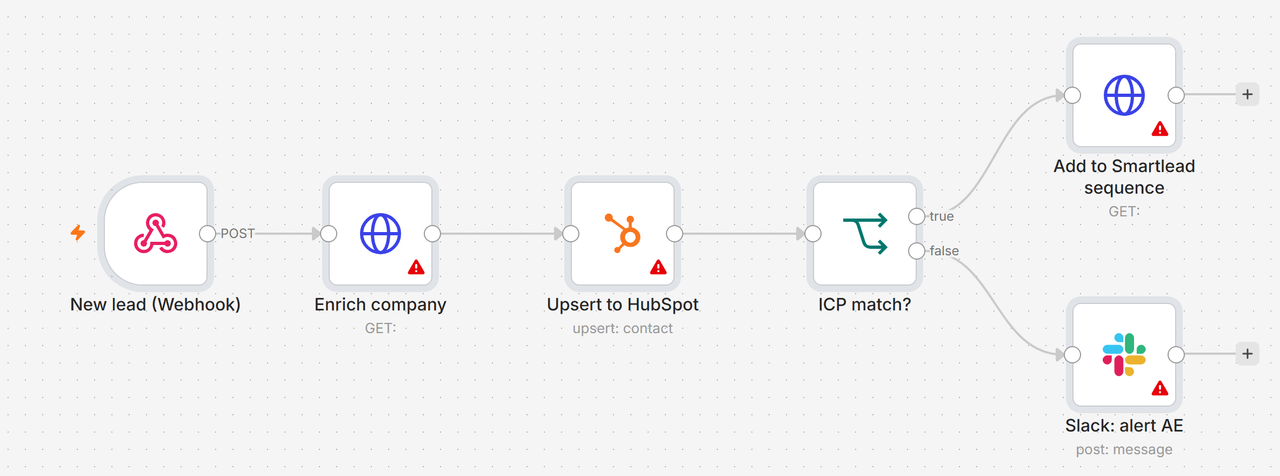
n8n is the right answer when you need to glue the other two together with the rest of your stack, when compliance requires self-hosted infrastructure, or when the automation logic is complex enough that a visual agent builder would abstract away too much control. My current recommendation for most teams: run Relevance AI agents that fire via webhook into n8n, then let n8n handle CRM writes, Slack alerts, and Smartlead enrollment downstream. That combination outperforms any of the three tools running in isolation. Don’t try to make Relevance AI do the integration plumbing. That is not what it is for.
Choose Relevance AI if
- You need a RevOps team or operator deploying AI agents to a full sales floor, not just one rep
- Your workflow involves multi-step prospecting: find account, score it, draft outreach, enrich contact
- You want native HubSpot or Salesforce write-back without writing custom integration code
Choose Lindy if
- An individual SDR or AE wants to automate their own inbox triage, follow-up reminders, and call prep
- Your team will not maintain a visual workflow builder and needs natural language configuration
- You want a quick win on rep productivity without a formal RevOps deployment
Choose n8n if
- You need self-hosted infrastructure for compliance, data residency, or cost control at volume
- The automation logic requires combining deterministic business rules with LLM decision nodes
- You are already running n8n for non-AI workflows and want to add agent nodes to an existing stack
The verdict on AI agent builders for GTM
The AI agent category is real. It is producing measurable pipeline impact for the teams deploying it well. But the tools are still early, and the marketing is running well ahead of the actual product maturity.
Relevance AI’s documentation has improved significantly in 2025 and the Agent Workforce model maps well to how GTM teams actually operate. Lindy is the right tool for the rep-level use case but should not be sold internally as a RevOps platform. That framing sets it up to fail. And n8n, which I cover in depth across this site because it sits at the core of so many modern GTM stacks, has crossed a threshold where its AI agent nodes are production-ready for operators who know the tool. The n8n AI agent documentation is worth reading even if you end up choosing a higher-abstraction tool. Understanding what is happening under the hood makes you a better buyer and a sharper evaluator when vendors start showing you demos.
According to G2’s AI Agent Software category, buyer interest in this space doubled in the first half of 2025. Vendors are racing to ship features. The gap between these tools will look different in six months. Lock in your evaluation criteria now. Not the vendor, the criteria.
Sources
Frequently asked questions
What is the difference between Relevance AI and Lindy?
Relevance AI is built for team-deployed, multi-agent sales and GTM workflows, while Lindy focuses on personal AI assistants that handle tasks like scheduling, email triage, and meeting prep for individual users.
Can Relevance AI replace n8n for workflow automation?
Not entirely. Relevance AI handles AI agent logic well but lacks n8n's breadth of native integrations and self-hosting options, so most serious GTM teams use both in tandem.
Is Lindy good for B2B sales automation?
Lindy works well for individual SDR or AE productivity tasks, but it is not designed for team-wide orchestration or complex multi-step prospecting sequences.
Does n8n support AI agents?
Yes. n8n added native AI agent nodes and LangChain integration in 2024, making it a credible option for teams that want code-level control over their AI workflows.
How much does Relevance AI cost?
Relevance AI starts at a free tier with limited credits, with paid plans beginning around $19 per month for individuals and scaling to custom enterprise pricing for larger teams.