GuidesReview
Lemlist Review 2026: The Honest Take for B2B Outbound Teams
An honest lemlist review for RevOps teams in 2026. Covers deliverability, AI personalization, pricing, and how it stacks up against Instantly, Smartlead, and Reply.io.

The tools compared
Entry prices from the pricing index, read Aug 12, 2026
Some links on this page are affiliate links. If you buy through them we may earn a commission at no cost to you; it never changes a verdict. How we make money
The short answer
Lemlist is the best cold email tool for teams that prioritize creative personalization and multichannel sequences, but Smartlead or Instantly will beat it on raw sending volume and cost per mailbox.
Here is my honest take on Lemlist: it sits in a weird middle position in the 2026 market. Better than most tools at creative personalization and multichannel sequencing. More expensive than the pure-volume senders. And occasionally frustrating in ways that matter at scale. If you are evaluating it right now, this review covers what actually works, what does not, and exactly when I would recommend Smartlead, Instantly, or Reply.io instead.
What lemlist actually does well in 2026
The core value proposition has not changed. Lemlist lets you build sequences that mix email, LinkedIn connection requests, LinkedIn messages, and manual call tasks on a single visual timeline. Where it pulls ahead of simpler tools is the personalization layer.
You can drop a dynamically generated image into an email (think: a screenshot of the prospect’s website with a sticky note overlay, generated on send) without touching a line of code. Even basic image personalization can help a sequence stand out against plain text. That is meaningful at the top of funnel, and most tools in this category simply cannot match it.
The lemwarm deliverability network is baked into every plan now, not sold separately. That matters. Inbox placement is the unglamorous variable that kills otherwise solid sequences. Once you start sending, watch your domain reputation and spam rate in Google Postmaster Tools. Skip the third-party warmup tools entirely here.
The Clay integration deserves a specific callout. If your workflow involves enriching a prospect in Clay (pulling job change signals, tech stack data, LinkedIn snippets) and then triggering a sequence, lemlist handles that handoff cleanly via its native integration. This is the playbook my team defaults to now. We have a full breakdown of that loop in the LinkedIn outbound loop guide for Clay, lemlist, and HubSpot.
Where lemlist falls short
Pricing is the biggest friction point. Full stop. The per-user model means costs compound fast as your team grows. A three-rep team on Email Pro ($69/seat/month) hits $207/month before a single add-on. Compare that to Smartlead or Instantly, where the model is flipped: you pay a flat fee and scale mailboxes nearly without limit. For teams running aggressive infrastructure plays (50-plus sending accounts, rotating warmup pools), those tools are structurally cheaper. Lemlist cannot compete on that dimension and does not pretend to.
The reporting dashboard is functional but not RevOps-grade. Aggregate open and reply rates are there. Attribution back to a CRM deal, sequence-level A/B test significance, per-variant conversion rates, none of that is native. I have had to supplement it with HubSpot reporting or a Looker Studio build on the API data more than once. If your RevOps team expects pipeline-level reporting from the sending tool itself, manage that expectation before you buy.
The AI copy features (“AI Variables” and the campaign assistant) are decent for breaking writer’s block. Do not rely on them for final copy without a human pass. The output is GPT-4-class but not tuned for cold email the way Reply.io’s Jason AI is. Use it to generate first-draft scaffolding, then rewrite.
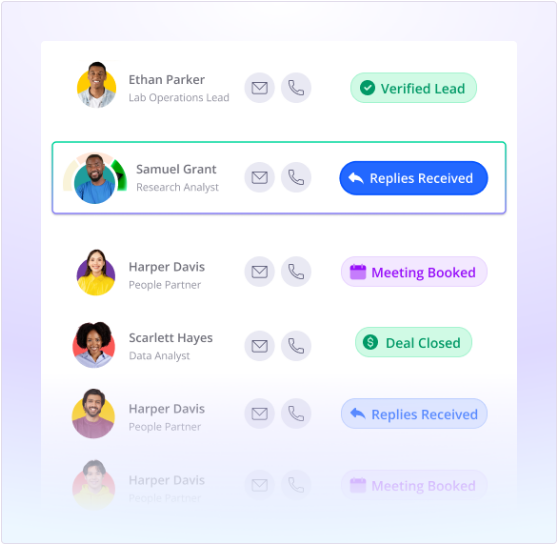
Lemlist vs. Instantly vs. Smartlead vs. Reply.io
Which cold outreach tool fits your team?
Choose Lemlist if

- You need email + LinkedIn + calls in one sequence canvas
- Personalized images or video thumbnails are part of your playbook
- You are connecting to a Clay enrichment workflow and want a clean handoff
Choose Instantly if

- You are scaling to dozens or hundreds of sending mailboxes
- Raw volume and cost-per-mailbox are the primary constraints
- You want AI reply categorization built into the inbox view
Choose Smartlead if

- You want unlimited mailboxes on a flat monthly plan
- Deliverability infrastructure and warmup rotation are top priority
- Your team runs high-volume cold email as a core acquisition channel
Choose Reply.io if

- You want AI-powered response handling and follow-up generation
- Your SDR team needs a built-in power dialer alongside email
- You want deeper Salesforce or HubSpot two-way sync out of the box
How to choose
One question settles this: are you optimizing for creative personalization and multichannel sequencing, or for raw infrastructure scale?
If your sequences live entirely in email and your goal is to spin up 30 sending accounts with automated warmup rotation, lemlist is the wrong tool. Smartlead’s unlimited mailbox model and Instantly’s flat pricing will cost you half as much for the same send volume. G2’s cold email software category consistently ranks Smartlead and Instantly higher for ease of scaling, which lines up with what I see in practice.
If you are running an SDR team where each rep owns a multichannel sequence that touches LinkedIn, sends personalized images, and needs a call task queue, lemlist is the best single-tool answer I know. The alternative is stitching together a separate LinkedIn automation tool, a separate email sender, and a task manager. That creates sync headaches that eat more time than the cost savings justify. If you are already considering moving off lemlist for volume reasons, read the migrate lemlist to Smartlead guide before you commit.
The bottom line on lemlist in 2026
Lemlist earns its place for teams that need a true multichannel outbound tool with strong personalization depth and a clean path to enrichment-first workflows via Clay and similar tools. It is not the cheapest option. It is not the right tool for pure infrastructure scale plays.
For a five-to-fifteen person outbound team running considered, personalized sequences across email and LinkedIn, it remains, in my view, the most complete single-tool answer in this category. Reply.io is the closest competitor for teams that want deeper AI-driven reply handling. Smartlead wins on volume economics. Know what you are optimizing for and the decision becomes straightforward.
Sources
Frequently asked questions
Is lemlist good for cold email in 2026?
Yes, lemlist remains a strong choice for B2B cold email, especially if you rely on image or video personalization and LinkedIn steps in the same sequence. Its deliverability infrastructure has improved significantly with lemwarm built in.
How much does lemlist cost in 2026?
Lemlist starts at $39/month for the Email Starter plan. The Email Pro plan runs $69/month, and the Multichannel Expert plan is $99/month. Annual billing drops those prices by roughly 20 percent.
How does lemlist compare to Instantly?
Instantly wins on mailbox scalability and cost per sending account. Lemlist wins on multichannel sequencing, native LinkedIn steps, and personalization depth. They serve different use cases.
Does lemlist have a free trial?
Lemlist offers a 14-day free trial on all plans, no credit card required.
Can lemlist integrate with Clay?
Yes. Lemlist has a native Clay integration that lets you push enriched leads from a Clay table directly into a lemlist sequence, which is one of the more useful connections in the modern outbound stack.