GuidesNewsletter
Beehiiv + Kit Newsletter Automation Stack Under $300
How to combine Beehiiv's growth features with Kit's simplicity and n8n automation into a newsletter stack that stays under $300/month.

The tools compared
Entry prices from the pricing index, read Aug 12, 2026
Some links on this page are affiliate links. If you buy through them we may earn a commission at no cost to you; it never changes a verdict. How we make money
The short answer
Run Beehiiv for referral programs and paid tiers, Kit as your CMS and sequence engine, and n8n to wire them together for under $300 per month total.
Most newsletter operators land in one of two traps. They pick Beehiiv and hit a ceiling the moment they want conditional automations with any real branching logic. Or they pick Kit and realize there is no native referral engine, no boost-style paid acquisition channel, nothing. I have been consulting on newsletter infrastructure for B2B operators at Homegrown Growth Co. for a few years now, and the stack I keep landing on is exactly this: Beehiiv handles the growth surface, Kit handles the sequence and CMS layer, and n8n wires the two together for under $300/month total.
The best newsletter stack is not the one with the most features in a single tool. It is the one where each tool does the one job it is genuinely best at, and automation fills the gaps.
Why the dual-stack makes sense
Beehiiv and Kit solve almost opposite problems. That is exactly why they pair well.
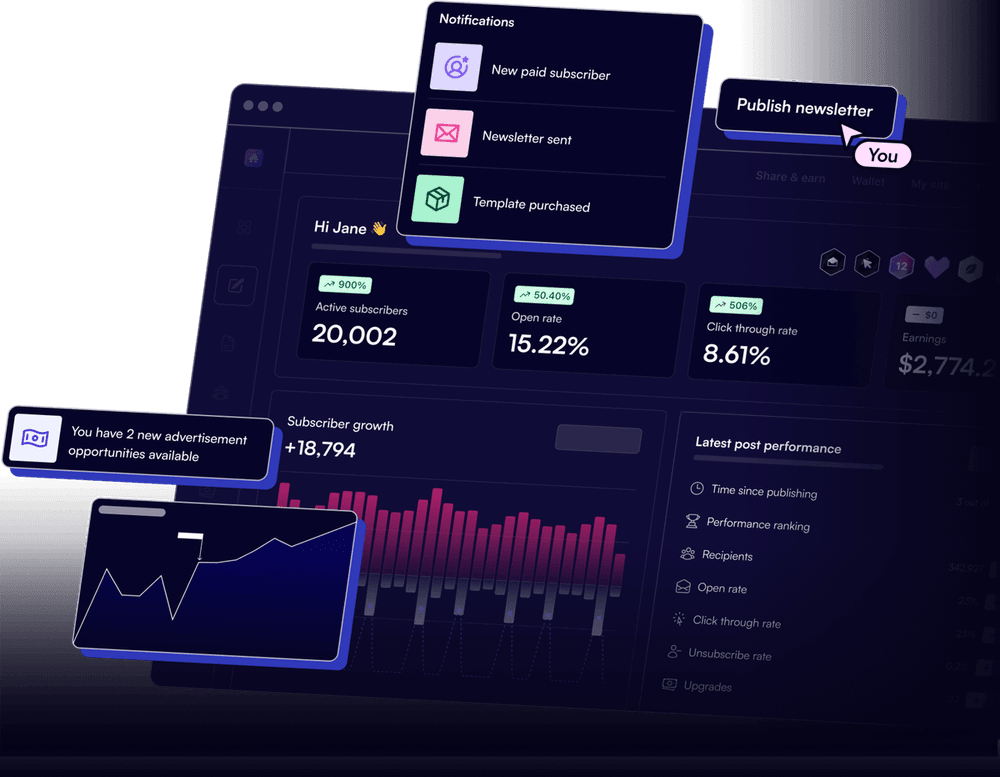
Beehiiv is built around acquisition and monetization. The referral program, Boosts (paid subscriber acquisition), and native premium subscription tiers are all first-class features baked into the platform. The editor is clean, the analytics are solid, and the Beehiiv ad network is genuinely useful for monetization once you clear 5,000 subscribers. What Beehiiv is not good at is complex conditional logic. Its automations are linear. You can trigger a welcome sequence, sure, but modeling a multi-branch behavioral flow like “subscriber opened three issues, bought nothing, clicked pricing twice” takes real work to build natively and even more work to maintain.
Kit is the opposite. The visual automation builder handles conditional branching, tagging, scoring, and commerce triggers cleanly. It started as ConvertKit and the DNA is still squarely in the creator-economy CMS space. Sequence editor is solid, you can gate content behind subscriber tags, and Kit’s native commerce layer (tip jars, digital products) is simpler to configure than Beehiiv’s premium tiers if you already sell other things. What Kit lacks entirely is any equivalent to Beehiiv’s referral engine. There is no boost-style paid acquisition channel either. You would need three separate tools to approximate what Beehiiv gives you natively.
My recommendation: do not try to replicate one platform’s strengths inside the other. Draw a hard boundary and let each tool own its lane.
How to build the stack
The architecture is straightforward. Beehiiv is the subscriber front door and monetization layer. Kit is the behavioral automation and sequence engine. n8n is the sync layer that keeps both systems honest.
All new subscribers enter via your Beehiiv subscribe page. This keeps referral tracking, Boosts attribution, and premium tier upgrades flowing through Beehiiv natively. Do not split your subscribe form between the two tools. The moment you do, you poison your referral attribution and it is painful to untangle. Beehiiv's embed form goes on your website. Kit's forms stay internal, triggered by automations, never public-facing in this stack.
In n8n, create a webhook trigger that fires on Beehiiv's 'new subscriber' webhook event. The n8n node hits Kit's API to create or update a subscriber, passing the email, first name, and a tag like 'source: beehiiv'. That tag is your audit trail. Map Beehiiv's custom fields to Kit custom fields at this step so segment data does not get dropped. The n8n workflow should fire within 60 seconds of signup so Kit's welcome sequence runs fast.
Kit owns all sequence logic: welcome drip, re-engagement flow for subscribers who go dark after 30 days, and upgrade nurture for free subscribers who have opened 5+ issues. Build these as Kit automations triggered by tags. When Beehiiv fires a 'subscriber upgraded to premium' event, n8n catches it, adds a tag in Kit like 'tier: premium', and Kit's automation removes the upgrade nurture sequence and starts the premium onboarding drip. Clean, auditable separation.
Beehiiv's referral program fires webhook events when a subscriber hits a milestone (1 referral, 5 referrals, etc.). In n8n, catch those events and write Kit tags like 'referral-tier: advocate' or 'referred: 5'. Now you can build Kit automations that treat high referrers differently: earlier access to new content, a personal thank-you sequence, an upgrade offer. This is the part you genuinely cannot do natively in either tool alone, and it is where the dual-stack earns its keep.
When a paid Beehiiv subscriber cancels, n8n catches the cancellation webhook, updates the Kit subscriber tag from 'tier: premium' to 'tier: churned', and triggers a Kit win-back sequence. Build in a 3-day delay before the first email. Pestering someone the same day they cancel is a good way to get a spam report. After 30 days of no re-conversion, n8n updates a custom field in Kit and suppresses that subscriber from pitch emails for 90 days. This protects your list health and your deliverability.
The gotcha: Beehiiv deduplication
Beehiiv and Kit both store subscribers by email, but Beehiiv is case-sensitive on some webhook payloads. A common failure is n8n creating duplicate Kit subscribers because Jane@example.com and jane@example.com were treated as two different records. Build a lowercase normalization step into every n8n node that handles email values before hitting the Kit API. One line of JavaScript in an n8n Function node prevents hours of list cleanup later.
// n8n Function node: normalize email before Kit API call
const email = $input.item.json.email
  .toLowerCase()
  .trim();

const firstName = $input.item.json.first_name || '';

return {
  json: {
    email,
    first_name: firstName,
    tags: ['source: beehiiv'],
  }
};
 and Slack nodes](/screenshots/n8n.png)
Who this stack is actually for
Not everyone needs both tools. Here is how to decide.
Which configuration fits your situation
Choose Beehiiv only if

- Your growth engine is referrals and Boosts, and your sequences are simple (welcome plus 1-2 nurture emails)
- You want one platform bill and are comfortable with the automation ceiling
- You are monetizing primarily through the ad network or native premium tiers, not digital products
Choose Kit only if

- You need complex multi-branch automations and deep tagging without paying for growth infrastructure you will not use
- You already sell digital products or courses and want Kit's native commerce layer
- Your subscriber growth comes from SEO or paid ads, not referral programs
Choose Beehiiv + Kit + n8n if

- You want Beehiiv's referral engine and monetization infrastructure plus Kit's automation depth
- You have a list over 5,000 subscribers where behavioral segmentation meaningfully moves conversion rates
- You are comfortable maintaining n8n workflows or have a RevOps person on the team
The real cost breakdown
At current pricing, the full stack runs like this. Beehiiv Scale at $99/month (required for the referral program and premium tiers). Kit Creator at $25/month for up to 1,000 subscribers, or $50/month for up to 10,000. n8n Cloud at $20/month on the Starter tier, which covers 2,500 executions per month and is plenty for a list under 50,000. That puts you at $144 to $169/month at the lower list sizes, scaling toward $250/month as your list grows toward 50,000 on Kit’s Creator plan.
If you self-host n8n on a Hetzner VPS at $6/month, you trim another $14 off the bill and get unlimited executions. Worth doing once your workflows are stable. The Kit pricing page and Beehiiv pricing page are the sources of truth here since both platforms have adjusted tiers in the last 12 months.
One more number worth keeping in mind: according to Lenny’s Newsletter on creator monetization, the median newsletter crossing $10k/month in revenue runs a paid conversion rate between 3 and 8 percent of the free list. At 5,000 free subscribers and a $10/month premium tier, converting 5% is $2,500 MRR. The Beehiiv Scale tier pays for itself within the first two paid conversions per month. The math is not complicated. The stack cost is a rounding error compared to what functional monetization infrastructure produces.
Sources
Frequently asked questions
Can you use Beehiiv and Kit together?
Yes. Most operators use Beehiiv for its growth infrastructure (referral, boosts, paid tiers) and Kit for automations and tagging, syncing subscribers between them via n8n or Zapier.
Is Beehiiv or Kit better for newsletter automation?
Kit has more flexible automation logic and tagging. Beehiiv wins on native growth features like referral programs and premium subscription tiers built into the platform.
How much does a Beehiiv plus Kit stack cost per month?
Beehiiv Scale starts at $99/month, Kit Creator starts at $25/month for small lists, and n8n Cloud runs around $20/month, putting the full stack well under $300.
What can n8n automate between Beehiiv and Kit?
n8n can sync new subscribers bidirectionally, mirror referral milestones as Kit tags, trigger welcome sequences in Kit when someone upgrades on Beehiiv, and route churned paid subscribers to win-back flows.
Do I need both Beehiiv and Kit or can I pick one?
Most solo operators can pick one. The dual-stack makes sense when you want Beehiiv's monetization infrastructure but need Kit's sequence depth or its native commerce integrations.