GuidesAi Voice
Bland AI + HubSpot + n8n: Book Meetings on Autopilot
Step-by-step recipe to connect Bland AI voice agents to HubSpot via n8n, auto-qualify leads, and drop booked meetings straight into your CRM.

The tools compared
Entry prices from the pricing index, read Aug 12, 2026
Some links on this page are affiliate links. If you buy through them we may earn a commission at no cost to you; it never changes a verdict. How we make money
The short answer
You can connect Bland AI to HubSpot using n8n as the middleware, so AI voice calls trigger automatically from HubSpot lifecycle changes, qualify leads in real time, and write booked Cal.com meetings back to the contact record without human intervention.
Most teams building AI voice into their GTM motion are still doing it manually: export a list, upload it to the dialer, review recordings, update the CRM by hand. That process wipes out most of the ROI before the first call even lands. This post is a concrete recipe for closing that loop completely, using Bland AI, n8n, HubSpot, and Cal.com so that a lead hitting a lifecycle trigger fires a call, qualifies itself, and drops a booked meeting on your calendar without a human touching anything.
Why this stack, and why now
AI voice is the fastest-moving category in GTM right now. Bland AI has emerged as the developer-friendly choice for teams that want full prompt control without paying enterprise voice platform prices. The catch: Bland AI is an API product. It does not ship a HubSpot connector out of the box, which means every team either hacks together a Zapier workaround (fragile, expensive at volume) or builds the real thing in n8n.
I’ve personally watched the Zapier version collapse at around 500 calls per month because of timeout errors and missing webhook retries. n8n handles this better because you own the execution environment and can add retry logic, error branches, and custom credential handling that Zaps simply do not expose. Don’t bother with Zapier for anything above a few hundred calls monthly. The failure modes are silent and the debugging is painful.
The workflow I’m going to walk through does four things:
- Detects a HubSpot contact moving to “Marketing Qualified Lead” (or any trigger you define)
- Fires a Bland AI outbound call with a dynamic prompt built from HubSpot contact properties
- Parses the post-call transcript and call outcome from Bland AI’s webhook
- Writes the outcome back to HubSpot and, if the contact booked, creates a Cal.com event linked to the contact record
This pairs naturally with what we covered in our HubSpot and n8n lead routing guide, so if you haven’t set up your n8n-to-HubSpot credential yet, start there.
Build it: step by step
Before you start, collect these credentials: Bland AI API key (from your Bland dashboard), a HubSpot private app token with crm.objects.contacts.read and crm.objects.contacts.write scopes, a Cal.com API key if you want to pre-generate booking links, and n8n running either on Cloud or self-hosted.
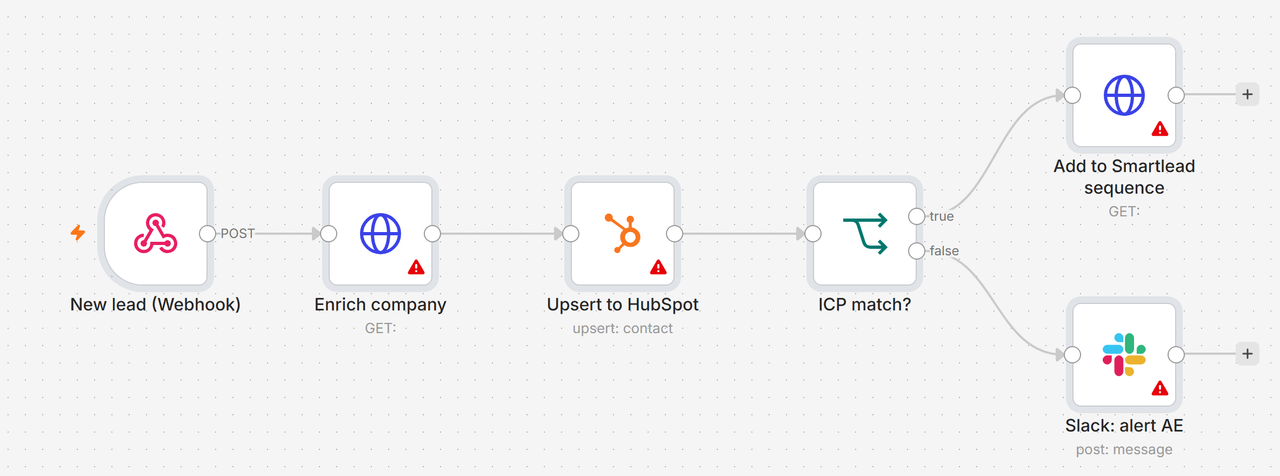
Add a HubSpot Trigger node set to fire on 'Contact property change'. Set the property to 'lifecyclestage' and filter for value equals 'marketingqualifiedlead'. This fires your workflow the moment HubSpot stamps the contact. Alternatively, use a Webhook node and set up a HubSpot workflow inside the CRM to POST to n8n, which gives you more control over batching and avoids polling limits.
The HubSpot trigger payload is thin. Add an HTTP Request node immediately after, pointing to the HubSpot Contacts API: GET /crm/v3/objects/contacts/{contactId}?properties=firstname,lastname,phone,company,jobtitle. This gives you the merge fields you need to personalize the Bland AI prompt. Store the response in a Set node so downstream nodes can reference clean field names without dot-walking deep into JSON.
Add another HTTP Request node, method POST, URL https://api.bland.ai/v1/calls, with your Bland API key as a Bearer token. In the JSON body, set 'phone_number' from the HubSpot contact data, 'task' to your prompt string (inline the contact's first name and company using n8n expressions), 'voice' to your chosen voice ID, and 'webhook' to an n8n Webhook node URL you have staged to receive the post-call payload. Set 'max_duration' to 4 minutes to cap costs. Log the returned call_id to a HubSpot note so you can correlate outcomes later.
Stage a second Webhook node in n8n as your Bland AI callback. When the call ends, Bland posts the transcript, call status, duration, and any extracted variables you configured in your prompt. Add a Switch node on 'call_status': branch for 'completed', 'no-answer', and 'voicemail'. On the completed branch, use an AI node or a simple regex to extract intent signals from the transcript, such as whether the contact said yes to a meeting.
On the 'meeting interested' branch, fire a Cal.com API call (POST /v1/bookings) with the contact's email and the time slot Bland extracted, or simply update the HubSpot contact with a custom property 'bland_outcome' set to 'interested' and enroll them in a HubSpot sequence that sends the Cal.com booking link via email. On the 'no-answer' branch, set a HubSpot task for re-dial in 4 hours. On 'voicemail', update the contact stage and trigger an email fallback.
The gotchas I hit building this
Two places I burned time on this. First: Bland AI’s webhook fires asynchronously, and the call_id in the trigger payload does not automatically correlate to your HubSpot contact. You need to pass the HubSpot contact ID as a custom metadata field in your Bland call request, then read it back from the webhook payload to route the update correctly.
Gotcha: lost correlation between call and contact
If you forget to embed the HubSpot contact ID in the Bland API request body, your post-call webhook arrives with a transcript and no way to know which CRM record to update. I’ve seen teams build a separate lookup table in Airtable to fix this retroactively. It’s a mess, and it’s entirely avoidable.
The fix is one extra field in the call payload and a single n8n expression on the receiving webhook. Do it from the start.
{
  "phone_number": "{{$node.Contact.json.phone}}",
  "task": "You are calling {{$node.Contact.json.firstname}} at {{$node.Contact.json.company}}...",
  "voice": "josh",
  "max_duration": 4,
  "webhook": "https://your-n8n-instance.com/webhook/bland-callback",
  "metadata": {
    "hs_contact_id": "{{$node.Contact.json.id}}",
    "hs_owner_id": "{{$node.Contact.json.hubspot_owner_id}}"
  }
}
Second gotcha: HubSpot’s private app token does not have webhook subscription permissions by default. You need to set up subscriptions in the HubSpot developer portal under your app’s “Webhooks” tab, not just in n8n. If your trigger node is firing zero events, that is almost certainly why. I’ve wasted an embarrassing amount of time on that exact thing before I internalized it.
For teams that want to go deeper on CRM enrichment patterns before calls fire, our Clay to n8n enrichment pipeline guide covers how to slot a data enrichment step between the HubSpot trigger and the call node, so Bland’s prompt includes firmographic context the rep never had to research.
Choosing your scheduling layer
Not every team needs Cal.com here. Here is how I’d frame the choice:
Which scheduling tool belongs in this stack?
Choose Cal.com if

- You want full API control over booking creation and can self-host
- Your team is cost-sensitive and the free tier covers your volume
- You need custom availability logic or round-robin across multiple reps
Choose Calendly if

- Your reps already live in Calendly and you do not want to migrate their links
- You need the booking embed to work inside an SMS or email with zero friction
- API access matters less than brand familiarity for prospects
Choose Chili Piper if

- You are routing meetings across a large AE team with complex territory rules
- You need instant Zoom link creation and CRM ownership assignment on book
- Concierge-style inbound routing is the primary use case
For most teams running this recipe at under 1,000 calls per month, Cal.com on the free tier is the right call. The Cal.com bookings API is clean, n8n has a Cal.com node in the community library, and you are not paying a per-seat tax on top of your Bland and HubSpot bills. Chili Piper is excellent, but the pricing only makes sense once you have a real AE bench to route across.
If you are already running a Synthflow or Vapi voice stack and evaluating whether Bland AI is worth the switch, we covered that decision in detail in the Vapi to Synthflow migration guide, and a lot of the API surface comparison carries over.
This workflow is worth building once
The Bland AI plus HubSpot plus n8n stack is one of those automations that pays back its build time in the first week. n8n workflows like this can cut inbound follow-up time from hours to minutes, which is the window that actually moves connect rates. The Bland AI prompt will need iteration, but the infrastructure you build here is reusable across any outbound or inbound motion you add later. Build it cleanly, embed the contact ID in metadata from day one, and let the HubSpot contact record become the source of truth for every call outcome.
Sources
Frequently asked questions
Can Bland AI integrate with HubSpot natively?
Not natively. Bland AI exposes a REST API and webhook events, so you need a middleware layer like n8n to read HubSpot triggers and push data back to contact records.
What does n8n do in this Bland AI HubSpot integration?
n8n acts as the orchestration layer: it listens for HubSpot lifecycle stage changes, fires the Bland AI call via HTTP Request, parses the post-call transcript, and updates the HubSpot contact with outcome data and a Cal.com booking link.
How much does this Bland AI HubSpot n8n stack cost per month?
Rough floor is around 150 to 300 USD per month: Bland AI at roughly 0.09 per minute, n8n Cloud Starter at 20 per month, and HubSpot Sales Starter at 15 per seat. Cal.com has a free tier that covers most teams.
Does Bland AI support Cal.com scheduling inside the call?
Yes. You can pass a Cal.com booking URL as a variable in the Bland AI prompt, and the agent can read it aloud or send it via SMS post-call. n8n handles creating the Cal.com booking link before the call fires.
What happens if Bland AI cannot reach the prospect?
Bland AI returns a call status of no-answer or voicemail in the webhook payload. Your n8n workflow can branch on that status to re-enqueue the contact in HubSpot or trigger a follow-up email sequence instead.