GuidesTool vs tool
Pipedrive vs Attio: Which CRM Wins for GTM Teams in 2026
Pipedrive vs Attio compared for modern GTM teams. Pipeline UI, automation depth, data model flexibility, and which one actually fits your motion in 2026.

The tools compared
Entry prices from the pricing index, read Aug 12, 2026
Some links on this page are affiliate links. If you buy through them we may earn a commission at no cost to you; it never changes a verdict. How we make money
The short answer
Attio wins for product-led and signal-driven GTM teams that need a flexible data model, while Pipedrive remains the better choice for field-sales and SMB teams who live in a visual pipeline.
The CRM you pick in 2026 is a GTM architecture decision, not a software preference. I keep watching early-to-mid-stage B2B SaaS teams default to Pipedrive because it is familiar and cheap, then spend 18 months duct-taping it to their signal stack before finally migrating. Meanwhile, Attio has quietly matured from “the pretty Notion-like CRM” into a genuinely capable GTM platform. This post breaks down exactly where each tool wins, where each falls short, and which motion each actually fits.
Where each tool actually lives in your stack
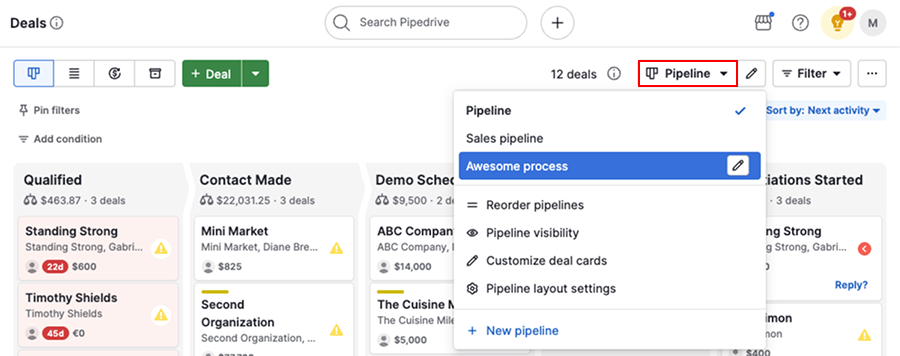
Pipedrive was built for a world where a sales rep owns a deal from first touch to closed-won. Everything, the pipeline board, the activity reminders, the email sync, orbits around that deal-centric mental model. That is still a completely valid world for a lot of teams. Small outbound teams can run happily on Pipedrive precisely because it does not try to be anything it is not.
Attio was built for a world where the CRM needs to model your business, not force your business into a CRM’s pre-existing schema. You can create custom objects (not just custom fields), build automations that trigger on attribute changes, and use workspace-level views that look closer to a Notion database than a traditional CRM. If your GTM motion involves tracking community members who later become customers, or correlating product usage signals with sales outreach, Attio’s data model is meaningfully better. The difference is not cosmetic. It changes what questions you can even ask of your revenue data.
Data model flexibility
Pipeline UI speed
Native enrichment
Automation depth
Onboarding speed
Price at 10 seats
How to choose
Most teams picking between Pipedrive and Attio are not really comparing feature lists. They are choosing between two different theories of what a CRM should do.
Pipedrive assumes your revenue process is linear and deal-centric. Attio assumes your revenue process is relational, multi-object, and increasingly signal-driven. If you are running a classic outbound SDR motion with defined stages and a quota-carrying AE closing deals, Pipedrive gets you productive faster and costs less. Full stop. If you are doing anything that involves tracking companies through a community, a product trial, a content funnel, or a partner motion before they ever talk to sales, Attio’s object model will save you months of custom-field hacking.
I would also factor in where you are on the migrate Pipedrive to HubSpot risk curve. Teams that have already outgrown Pipedrive and are considering HubSpot should seriously evaluate Attio first. At comparable team sizes, Attio is cheaper than HubSpot’s Sales Hub Professional and easier to administer than Salesforce. The HubSpot to Attio migration path is also well-documented if you are coming from the other direction.
Two other CRMs worth naming here. Folk is excellent for founder-led or relationship-first GTM where the CRM is more of a contact intelligence layer than a pipeline tool. Salesflare auto-captures email and meeting data in ways both Pipedrive and Attio require configuration for, making it the lowest-admin option for a two-to-five person team. Neither replaces Attio or Pipedrive at scale, but they are honest alternatives for the right profile.
Which CRM fits your motion?
Choose Pipedrive if
- You run a quota-carrying SDR/AE split with defined pipeline stages
- Your team needs to be fully productive within 24 hours of signup
- Budget is a constraint and you want a capable CRM under $20/seat
Choose Attio if

- Your GTM motion is PLG, community-led, or involves non-linear buying journeys
- You need custom objects beyond contacts, companies, and deals
- You want native enrichment and attribute-triggered automations without stitching Zapier
Choose Folk if

- You are a founder or small team where relationship context matters more than pipeline stage
- You want a CRM that feels like a well-designed contacts app, not a sales tool
Choose Salesflare if

- You want zero-admin CRM that auto-logs emails, meetings, and LinkedIn touches
- Your team forgets to update the CRM and you need it to update itself
The bottom line for GTM operators
Pipedrive is not a legacy tool. It is a focused tool, and focused tools win when your motion is clear. Attio is not trying to be a HubSpot killer. It is a bet on a more flexible, signal-aware approach to CRM that fits the way modern B2B revenue actually flows through communities, trials, and warm outbound.
For teams pairing their CRM with enrichment tools like Clay or Apollo, Attio’s automation layer will handle more of the signal-to-action plumbing natively. Push a product usage event from Segment, trigger an enrichment sequence in Clay, update a custom Attio object, fire a Slack alert to the AE. That whole loop runs without Zapier. For teams running high-volume outbound sequences through Smartlead or Instantly, Pipedrive stays out of the way and lets those tools do their job. Pick the CRM that matches your motion. G2 ratings tell you nothing about fit.
Sources
Frequently asked questions
Is Attio better than Pipedrive for B2B SaaS?
Attio is better for B2B SaaS teams running product-led or signal-driven GTM motions. Pipedrive wins for teams that need a fast, opinionated sales pipeline with minimal setup.
How much does Attio cost compared to Pipedrive?
Attio starts at $34/seat/month (Plus) versus Pipedrive's $14/seat/month (Essential). Attio's Free tier covers up to 3 seats, making it accessible for early-stage teams.
Can Attio replace Salesforce for a small GTM team?
For teams under 50 seats without complex approval workflows, Attio can absolutely replace Salesforce and will feel significantly less painful to administer.
Does Pipedrive integrate with Clay and Apollo?
Yes. Pipedrive has native Zapier and Make integrations plus a REST API, making it straightforward to push enriched records from Clay or Apollo into deals and contacts.
What CRM is best for outbound-heavy GTM teams in 2026?
Pipedrive remains the most friction-free choice for outbound-heavy SDR teams. Attio is catching up with its enrichment integrations but lacks native sequence tooling.